Abraham, was born in 1701 and was christened on 21st May at St Dunstan, Stepney and went on to become a coal dealer and landowner living in Ratcliffe, Stepney.
In the 19th century Limehouse and Ratcliffe were notorious areas, catering to the locals and the huge influx of sailors and immigrants alike with their disreputable taverns, flophouses and brothels.
But while Limehouse has gone on to prosper – being transformed from a decaying industrial wasteland into a trendy residential area, with its restored 18th century houses – Ratcliffe has vanished. Ratcliffe was born as the first landfall for ships hitting the capital. The first wharf was built in 1348 and was the first recorded instance of the river being used for business east of the City.
The hamlet quickly grew, spreading north along Butcher Row, the main route to Stepney and Hackney. By the 17th century there were more people – 3,500 – living in Ratcliffe than in any of the other Stepney hamlets. Its bustling streets were lined with sailors’ houses, shipwrights’ offices and taverns.
But in 1794 disaster struck the area. A fire broke out on a barge loaded with saltpetre, the volatile substance used to make matches. This fire, at what is now the Free Trade Wharf, quickly spread to the wooden buildings on the shore, destroying the whole of the southern part of Ratcliffe.
Much rebuilding ensued, and with the huge influx of immigrants in the 19th century, the area changed drastically.
In 1801 the population of Ratcliffe was just 5,000; in 1861 it had soared to 17,000. Along the way, in 1840, it had been established as a parish district within Stepney, being split off from Limehouse.
The prosperous wharfingers and businessmen had now made way for sailors and dockers and Ratcliffe was entering the period of its greatest notoriety.
Broad Street, now the east end of The Highway, became a terrible slum. Ratcliffe became renowned for drunkenness, vice, opium dens and poverty. The authorities demanded that something be done.
Like Chinatown, in neighbouring Limehouse, Ratcliffe was planned out of existence. The building of the Commercial Road and of the London and Blackwall Railway demanded massive demolition; the digging of the Rotherhithe Tunnel did the rest.
As the 20th century rolled on, the laying out of the King Edward VII Memorial Park, the damage wreaked by the Luftwaffe’s bombs and the ongoing programme of slum clearance finished off Ratcliffe for good.
As its warehouses fell into decline, they were not allowed to stand, like those in neighbouring Wapping and Limehouse, but were cleared in the name of improvement.
Today, of course, those derelict warehouses have been renovated into smart new homes, while Ratcliffe lies buried beneath the roads, railways and tunnel diggings of the riverside.
The only reminder is Free Trade Wharf, which you approach from The Highway – once the Ratcliffe Highway – via a huge gateway, bearing lions and the coat of arms of the East India Company.
When you pass through the gate, originally built for the bustling area in 1796, you can reflect that you are walking on what was once one of the most infamous quarters of London – but now disappeared and almost forgotten.
On 18th Oct 1739 Abraham married Elizabeth Wildey in the Somerset House Chapel on the Strand.
Elizabeth was born abt 1705 in Stepney the daughter of Samuel Wildey (1679-1752) and his wife Lydia. Samuel was a coal merchant so it is safe to assume that Abraham either worked for him prior to marriage or went into his business after marrying Elizabeth.
What is certain is that Samuel Wildey was a substantial landowner and that, since his wife and two sons predeceased him, his business and land interests came into Abraham’s hands, via Elizabeth, on Samuel’s death. Samuel’s will was proved 14 Dec 1752 and in it he instructs that his body should be interred in the family vault at Saint Dunstan.
He also stipulated that “
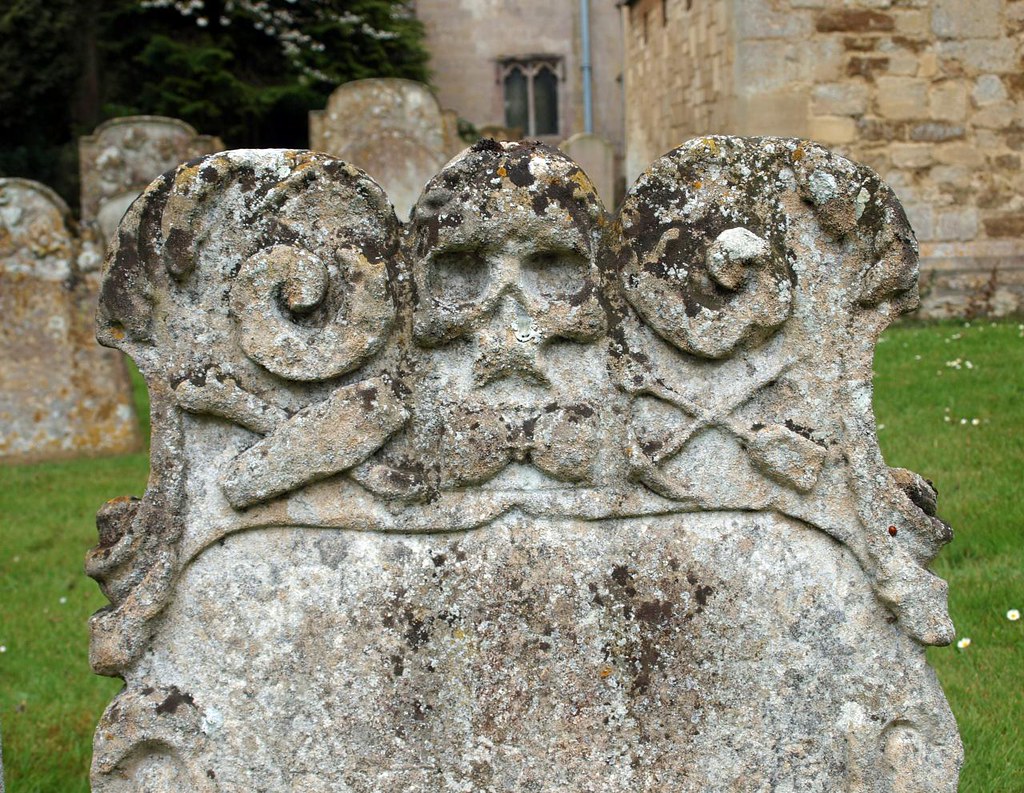
my body to be enclosed in a plain English oak coffin and to be carried in a hearse with four horses and two mourning coaches following with four horses to each coach and the corpse to be removed out of my house at eleven o'clock at night and the bearers be my own servants and to be deposited between the corpse of my late wife Lydia and my late son Richard, that of my wife to be placed on my left hand”. Unfortunately time, and acid rain, has dissolved the inscriptions on all the remaining vaults and headstones in the graveyard at St Dunstan’s so finding the family vaults of both Wildeys' and Robarts’ has proved impossible.
Amongst various other bequests he left his “
freehold messuages, lands, tenements and hereditaments situate and being in Wooburne, Little Marlow and elsewhere in the county of Bucks and also all those the tythes issuing, arising and payable to me out of my messuages, farms, lands or tenements whatsoever in the county of Berks and all other my real estate and also all my copyhold estate in the said parish of Stepney” as well as the “
residue and remainder of my ready money, securities for money, goods, debts, stocks in the public funds or companies stock in trade and all other the residue and remainder of my estate and effects whatsoever and wheresoever” to Elizabeth and therefore, by default, to Abraham (he also left her his household goods, plate, linen and jewels for her life which were to be sold after her death). This inheritance marked the beginning of the family fortunes which led to interests in the East India Company and the founding of a bank.
Samuel was the son of Richard Wildey (1641-1704) and Dorothy Butterfield (d.1699) – Dorothy was the daughter of Thomas Butterfield of Wooburn, Bucks and presumably bought the Wooburn land into the Wildey family either as a marriage settlement or upon inheritance. At his death in June 1662 Thomas was a prosperous yeoman “
possessed of 2,443 loads of billets valued at £610 15s., plus other wood valued at £129, while his barges, barge tackle and barge poles were valued at £90.” (Wooburn is on the river Wye which joins the Thames at Bourne End so presumably the barges were for ferrying his wood to markets).
Richard was a woodmonger and property owner based in Ratcliffe who states in his will “
my body I commit to the earth to be decently interred amongst my ancestors in the vault belonging to me and my family in the Churchyard of Stepney aforesaid and with this further direction to my executor that my funeral be decent but not superfluous and that none but my relations be invited thereunto”! He left Samuel “
the lease and premises which I hold from the company of Coopers of London (subject nevertheless to the said settlement made by me to my said wife ) and also all of my messuages, lands, tenements, parts of ships, lighters, vessels, stocks, moneys, debts, mortgages and all other my estate whatsoever both real and personal” under the supervision and guidance of his brother in law Edward Belitha who was a haberdasher and citizen of London.
In 1692 Richard Wildey was able to buy his son Samuel a share in Britain’s first life insurance scheme, the tontine. Richard had built a small property empire in Stepney: “
6 houses to the street, 6 to the wharf and 2 in the Little Alley” and when William III needed to raise money to pay for his European wars the following year, Richard’s tax bill came to £8 and 6 shillings.
Richard was in turn the son of Captain William Wildey and Sarah Dover. William Wildey, vestryman of St Dunstan in 1643 (basically a parish councillor), who was to become a rear-admiral, was an energetic, painstaking Commonwealth naval officer. In 1653 he was consulted regarding the fitness of forty ships for State service and until June was busy finding crews and victualling the fleet at Gravesend for war with Holland. In June 1653 he wrote from Ratcliffe to the Admiralty Committee, which must have reprimanded him, “
I must defend myself from your high displeasure of misrepresentation concerning me. I have been neither negligent nor unfaithful, and if I erred in carrying out your orders, it has been through misapprehension. I beg dismissal, as there are others better qualified”. He had been anxious that the crews were properly fed and clothed and constantly complained about the food.
He was married twice, first to Margaret Hawkins on 18th April 1626 and secondly to Sarah Dover on 13th February 1633, and died on 29th August 1679. Sarah died 6th April 1667. He left three sons, William, Richard and Thomas. The family lived in Stepney until 1782 when Samuel Wildey, the last of the male line, died.
William Wildey served in the Parliamentarian and Commonwealth navies. In 1646, he commanded the hired merchantman Charles, which was kept ready, but not used. Powell calls him Weldy in the list of ships held in reserve. In 1649, he commanded the 2nd Rate Charles (presumably the same ship which had been taken into service). Finally, in 1650, he was flag captain and commanded the 1st Rate Resolution – I have often wondered if this was the same ship that Abraham Robarts may have captained in 1692.
In August 1650 he commanded the flagship of Admiral Robert Blake during the pursuit of Prince Rupert to Lisbon. The King of Portugal refused to expel Rupert or to acknowledge the Commonwealth, so Blake seized the Portuguese treasure fleet from Brazil. When Rupert escaped from Lisbon into the Mediterranean, Blake continued his pursuit, attacking a detachment of Rupert's squadron in the neutral Spanish port of Cartagena and plundering French shipping when he took refuge in Toulon. Finally, with most of his fleet destroyed, Rupert fled into the Atlantic, and both Portugal and Spain agreed to recognise the Commonwealth.
Richard’s brothers, William and Thomas, both followed their father to sea, William was an EICO captain lost at sea in a hurricane in 1694 and was the Captain of their Majesty’s hired ship Modena and Thomas seems to have sailed, very successfully, on his own account since, in his will, he leaves “
the eighteen houses, gardens, courts and any other outlets and any other privileges thereunto belonging to me”.
Returning to Abraham; in his will he commits his body “
to the earth, to be decently buried at the discretion of my dear wife and at such place where she intends lying herself when dead” which is the beginning of the Robarts family vault in St Dunstan.
Amongst various bequests are a copyhold property “
at or near Stepney Causeway”, copyhold premises in Stoneyard, Ratcliffe, a share and interest in the new Ratcliffe ferry of which he is the proprietor, £700 to his son Samuel Wildey and £1500 apiece to his sons Abraham and George. He left in total, at his death, just over £9000.00 which, depending on how it is measured, is anywhere between £565,000.00 and £6 million in today’s money which indicates how successful he was.
Apart from property and, I assume, trade investments with the EICO a large part of his fortune came through loans to the government; at the time of his death he had “
four thousand pounds 4 percent annuities” and so he can be regarded as the informal founder of the banking interest.
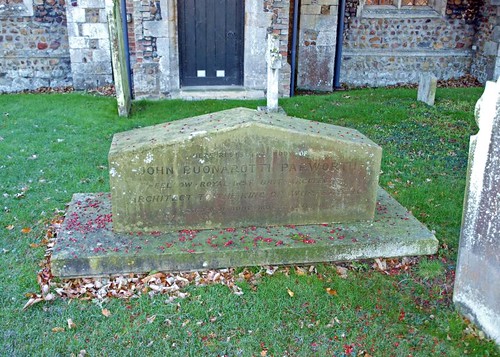
Abraham died in October 1761 and was buried in St Dunstan, Stepney in his family vault which was/is a large altar tomb, enclosed by iron railings. Arms: 3 cross bows, a label for difference, on an escutcheon of pretence, a chevron gouttée bet. 3 birds close, for Wildey. Crest: a stag lodged regardant.
He was survived by Elizabeth and three sons.
Elizabeth lived for another seven years, dying in November 1768, and in her will decides on her final resting place: “
my body I desire may be buried in a decent but not expensive manner and deposited in the vault in Stepney Churchyard as near to the remains of my late dear husband as may be”.
She goes on to discharge debts from her sons Samuel and Abraham; these were loans she had made “
for their advancement in the world”. Since Samuel had been amply provided for by her father’s and husband’s estates she left the bulk of her estate to her two younger sons Abraham and George but her household goods are to be divided equally between all three sons excluding some individual bequests.
Abraham Robarts and Elizabeth Wildey had 5 children:
• Richard Robarts 1740 – bef 1761; he died unmarried.
• Abram Robarts 1742 – 1742.
• Samuel Wildey Robarts born 27th Aug 1744 in Stepney, christened 13th Sep 1744 at St Dunstan and married Mary but had no children by her. Lt Colonel in His Majesty’s 28th or North Gloucester Regiment of Infantry (he sold his commission in 1794 for 4000 guineas) he was commissioned on 4th July 1759.
In 1734 Philip Bragg became Colonel of the Regiment which had been first raised in 1694 by John Gibson. Bragg was to command the Regiment for twenty-five years, until his death in 1759. In 1742 the British Army adopted a new, and initially very unpopular, numbering system for its regiments, which were no longer to be officially known by the names of their colonels. Bragg's Regiment became the 28th Foot, its red coats keeping the yellow facings of old. Many regiments, particularly the "Royal" regiments with blue facings to their coats, acquired fancier titles as well as numbers, which didn't always go down too well with colonels of less privileged, but just as proud, regiments. This in turn led to the regimental tradition of a drill command reputedly issued by one of Bragg's successors in the next century:
Neither King's nor Queen's, nor Royal Marines,
But 28th, Old Braggs: Brass before and Brass behind,
Never feared a foe of any kind;
Shoulder Arms!
In 1757 the 28th Foot sailed for the Americas with the Expeditionary Force under General Wolfe whose task was to wrest Canada from the French. The first action in which the Regiment was engaged was the Siege and Capture of Louisbourg, a strongly fortified post on the Eastern Seaboard of Nova Scotia. A year later they sailed with Wolfe up the hazardous St Lawrence River. After numerous unsuccessful attempts to gain a foothold on the mainland of Canada, a proposed plan of a silent landing below the cliffs of Quebec was conceived. On 13th September 1759 the 28th was the first regiment of the line to scale the Heights of Abraham following immediately behind 24 volunteers of the Light Infantry. When the army was drawn up to await General Montcalma’s attack it was at the head of the 28th that General Wolfe posted himself. The enemy advanced, firing as they came. When they were within 40 paces of the motionless redcoats Wolfe gave the order to fire. This first staggering volley and the quick succession of volleys that followed broke the French line, and at Wolfe's command the whole of his force advanced to achieve the victory that eventually won Canada for the British. Wolfe was wounded three times and survived just long enough to hear that victory was assured.
Samuel was unlikely to have been present at Quebec given that he only joined the Regiment in July 1759 and it took two to three months to sail to Canada but thereafter he would have been on active service.
On April 28 1760, at the defeat of Sainte-Foy (the last French/Indian victory of the war), the regiment was in Fraser's brigade on the left wing. It then took part in the expedition against Montréal.
In 1761, the regiment assumed garrison duty in Montréal for most of the year before being sent to the West Indies where it arrived in Carlisle Bay in Barbados on December 24.
In January and February 1762, the regiment took part in the expedition against Martinique and the siege of Fort Royal. Then, from March to August, it participated in the expedition against Cuba and the siege and capture of Havana suffering heavy losses from sickness during the following months. After a year in Cuba the regiment went to New York with a strength of only 208 men.
After the end of the Seven Years War (in 1768) the 28th Foot were on garrison duty in Montreal. Day-to-day life was made very difficult for the soldiery there by one Thomas Walker, an important merchant and magistrate of the city, particularly with regard to his failure to provide them with adequate quarters during the severe winter weather. The 28th decided to take revenge and on the night of 6th December a group of disguised men burst into Walker's house as he was sitting down to supper, beat him up and sliced off half his right ear.
The culprits were never brought to justice, although there was plenty of circumstantial evidence implicating Captain Payne, Lieutenant Tottenham, Sergeant Rogers, Sergeant Mee, Private Coleman, Private McLaughlan and four others.
"
It was a lesson to outsiders not to tamper with the 28th, and although the removal of magistrates' ears is to be deprecated, Mr. Walker seems to have pushed the forbearance of that spirited corps rather far. The affair became a cause celebre and resulted in resignations by high officials and kept the law courts busy and the Montreal tea tables chattering for four years. One thing emerged from the incident of Walker's Ear - a new name for the 28th - 'the Slashers'."
1768 produced a comprehensive set of instructions in the form of a new Royal Warrant for the army with regard to their dress, accoutrements and equipment. Each regiment was expected to comply with these regulations, and much attention was paid to the often minor but proud distinctions of uniform detail applicable to the diverse regiments, paying particular regard to the changes that had been made since the last Royal Warrant of 1742. Inspections became more frequent as standards had to be met. The 28th Regiment of Foot was the subject of an Inspection Return on 28th May 1768:
“
8 Fifers. Officers - coat with silver embroidered button-holes, cross pockets, lapelled to the waist with bright yellow; yellow cape; a small round cuff - silver buttons numbered; silver shoulder-knot. White waistcoat and breeches. A Company, called the Light Infantry Company, appeared clothed in short coats and caps, but have notwithstanding proper clothing like the other companies, when required to be worn.”
The Light Infantry Company mentioned above was a hangover from the Seven Years War, as such Light Companies were not officially to be included on the establishment of line infantry regiments until 1770. The 28th were unusual in retaining a Light Company as most other regiments which had seen active service dissolved theirs at the end of the Seven Years War in 1763.
The Battle of White Plains was an inconclusive action fought on 28th October 1776 outside New York with about 4,000 men engaged on each side - the British under the command of Major General Sir William Howe, the Americans led by General George Washington. The battle came about as a result of Howe's efforts to threaten Washington's lines of communication, while keeping New York safe in British hands. The 28th Foot were present in Second Brigade with the 5th, 35th and 49th Regiments.
The attack by the 28th Foot in company with the 35th provided an alternative or additional explanation of the regimental nickname of 'the Slashers'. As they advanced towards the American position, their way was hampered by the long grass through which they marched. Using their swords and bayonets like machetes, the 28th slashed their up the slope before charging and driving the Americans from their position at bayonet point.
On 13th March 1778 France recognised the independence of the United States of America, and thus Great Britain and France were at war again. The 28th Foot, together with the 4th, 5th, 15th, 27th, 35th, 40th, 46th, 49th and 50th Regiments, plus fifty Light Dragoons, embarked at Staten Island in New York, bound for the West Indies.
In a skilfully executed combined operation, the Royal Navy and the Army captured the island of St Lucia in December 1778. Admiral Samuel Barrington's squadron of twelve ships covered the landing of 6000 men under Major General Grant who overwhelmed the island's tiny garrison with ease. But it wasn't long before a French fleet hove in sight, twice as large as Barrington's, and escorting its own landing force, double in numbers that of Major General Grant.
Grant divided his force into three, manning the major strong points of the island. The first French attack fell upon La Vigie where Lieutenant-Colonel Meadows was posted with his three battalions, who were an interesting mix; the 5th Foot, the Grenadier battalion and the Light battalion, the latter two composed of the elite flank companies of all the British infantry regiments (including the 28th) landed on St Lucia. The entire French force attacked but were finally driven back as the British reached the end of their ammunition supply. Successive French attacks over the next several days on the two other British positions also met with failure. Within two weeks the French had evacuated the island and St Lucia was in British hands.
St Lucia was fought over no less than fourteen times between the French and the British between the 17th and 19th centuries, finally being ceded to the British in 1815, before final independence in 1979.
1782 saw the introduction of County titles to most of the Regiments of Foot in the British Army. Regiments had always recruited from far and wide in the kingdom and beyond, and, indeed, would continue to do so. Both the 28th and the 61st recruited heavily in Ireland for many years, as did many other regiments. However, the association of the various regiments with the counties of the British Isles increasingly came to mean that the army as whole began to develop the regional characteristics that were to stand it in good stead for the next two hundred or so years.
In any case, the numbering system was not abandoned. The 28th became the 28th (North Gloucestershire) Regiment of Foot and the 61st became the 61st (South Gloucestershire) Regiment of Foot. There were some difficulties and arguments as to which regiments should be allocated to which counties, for change is often painful.
On 1st February 1793 Revolutionary France declared war on Great Britain and the Netherlands, launching an invasion of the latter fifteen days later. With astonishing rapidity Britain sent an expeditionary force to the aid of its ally, which set sail from Greenwich later the same month. The following year the 28th Regiment set sail from England with more substantial reinforcements to join the Duke of York in Flanders and by August the Royal Duke's army was over 34,000 strong.
The 28th were to remain in Flanders for a year, in a campaign marked by dismal weather, logistical breakdowns and ill-conceived and poorly executed plans undertaken by the British and their Austrian and Dutch allies. Fortunately inadequate Allied strategy was saved from disaster by the professionalism of their soldiers and the even greater inefficiency of the French Revolutionary army at this time.
Two officers of the 28th were later to achieve greater fame in the wars against the armies of Napoleon in Spain and at Waterloo. Lieutenant Colonel Edward Paget would lead the regiment in Egypt and become a general under both Moore's and Wellington's commands, while Captain Hussey Vivian would later be a successful cavalry commander. And the Duke of York himself, although never to be marked out as a brilliant commander in the field, did a great deal to reform the army which was to be Wellington's instrument of victory.
• Abraham Robarts 1745 – 1816 of whom more below.
• George Robarts 1749-1805 christened 11 Sep 1749 St Dunstan. Nothing else known except his death notice: At Hull, George Robarts, Esq. formerly of Beverley, in Yorkshire, and brother to Abraham R. Esq. MP for Worcester and at some point he lived at Linfit Hall, in Slaithwaite.