I
have visited St Peter ad Vincula twice now and on both occasions the
church was in use - once for a Lenten service and the second time in
preparation for an upcoming concert - so have no interior photos but can
confirm that it contains many fine monuments, including a fine example
in the vestry to Mary
(Waters), wife of Robert Honywood, 1620, consisting of a painted figure
of a woman kneeling at her prayer-desk, flanked by Ionic columns
supporting a pediment, with a lozenge and 2 shields of arms, 2 skulls
and an animal, in black and coloured marble (removed from Marks Hall
parish church on its demolition in 1932), and brasses within.
The
church dates back to the 15th century, built from thee wealth generated
by the wool industry, and was bombed in 1940 and the tower, north wall
and roof were subsequently rebuilt. St Peter ad Vincula was, along with
St John the Baptist in Thaxted, a candidate for the cathedral of Essex,
but both lost out to Chelmsford Cathedral.
One
day I'll visit again, hopefully when it's quiet so that I can capture
the interior! I gained entry a month after I wrote this post.
ST
PETER-AD-VINCULA. A large church (c. 125 ft long) built to one plan in
the C15; W tower, nave and wide aisles, chancel and equally wide chancel
chapels. The chancel does not project at the E end; so the church is,
except for the tower, just a parallelogram. There is however a chancel
arch to separate nave from chancel, and there are short solid walls
projecting from the E end to separate altar spaces from each other. Nave
and tower are in ruins, due to the Second World War. W tower with
diagonal buttresses and battlements. The rest of the church also
embattled, including the two-storeyed S porch. Aisle walls flint-rubble, E
parts ashlar-faced. On entering the church from the S the
tierceron-vault of the porch with its bosses still exists. The nave and
chancel N and S arcades are of tall slender piers with four attached
shafts carrying capitals and four thin polygonal diagonal shafts with
concave sides and running on into the arches without capitals.
Four-centred arches. Clerestory windows of three lights. Aisle windows
large and also of three lights. Renewed E window of seven lights, E
windows of the chancel chapels of four lights - all with Perp panel
tracery. At the E end a frieze of shields at the base and below the E
window a cusped recess. - MONUMENTS. Brasses of John Paycocke d. 1533
and wife with indent of a brass of the Virgin above; in the floor of the N
(Paycocke) Chapel. In the same chapel Thomas Paycocke d. 1580; two
women of c. 1480. - In the S chapel Mary Honywood d. 1620, monument with
kneeling figure. From Markshall, transferred to Coggeshall, at the
demolition of Markshall church. The inscription says that Mrs Honywood
left 367 children, grandchildren, great-grand-children, and
great-great-grandchildren.


COGGESHALL.
Who has not heard of Paycocke's House? It is ours for all time, still
standing on the Roman road to Colchester. Look where you will in this
quaint town and carved beams meet your eye; there are 99 monuments here
scheduled by the Government. But among them all it is Paycocke's which
stands supreme, a complete example of a richly ornamented merchant's
house of Tudor days.
Its timbers overhang the road where all may
see them, its upper storey with a frieze of running foliage on it and
tiny heads, a shield with a merchant's mark of an ermine's tail, and the
initials of Thomas Paycocke himself, who died in 1580. Both storeys are
divided by buttresses into five bays. On the sideposts of an arch are
moulded pedestals, and under canopies are two statues of a man with a
shield and another man with a load on his shoulder. Indoors most of the
rooms have elaborately carved ceiling beams, original doorways,
linenfold panelling, and fireplaces carved with grotesque beasts.
Even
older than Thomas Paycocke's House is the inn Thomas would pass on his
way to church, called the Woolpack in compliment to the industry which
brought wealth to this town. Its embattled beams have supported the
gables 400 years, and one of its bedrooms has a handsome kingpost 500
years old.
The
church was made new amid the great prosperity of the 15th century, and
we know from the Roman bricks among the flint rubble of the walls that
it was refashioned from an older church. A perfect whole in construction
and design; its graceful columns and its great windows are delightful,
especially the seven-panelled east window, which looks big even from the
tower arch 40 yards away. The oak roof of the nave looks down from a
height of 40 feet and its old and new timbers rest on canopied figures
of the Apostles placed here last century. The font is 700 years old.
Engraved
on brass is the portrait of Thomas Paycocke, and on other brasses are
John Paycocke of 1533 with his wife, and William Goldwyre of 1514 with
his wife. Two other civilians are shown in rich robes of the 15th
century, and two unknown women in butterfly headdress. It was probably
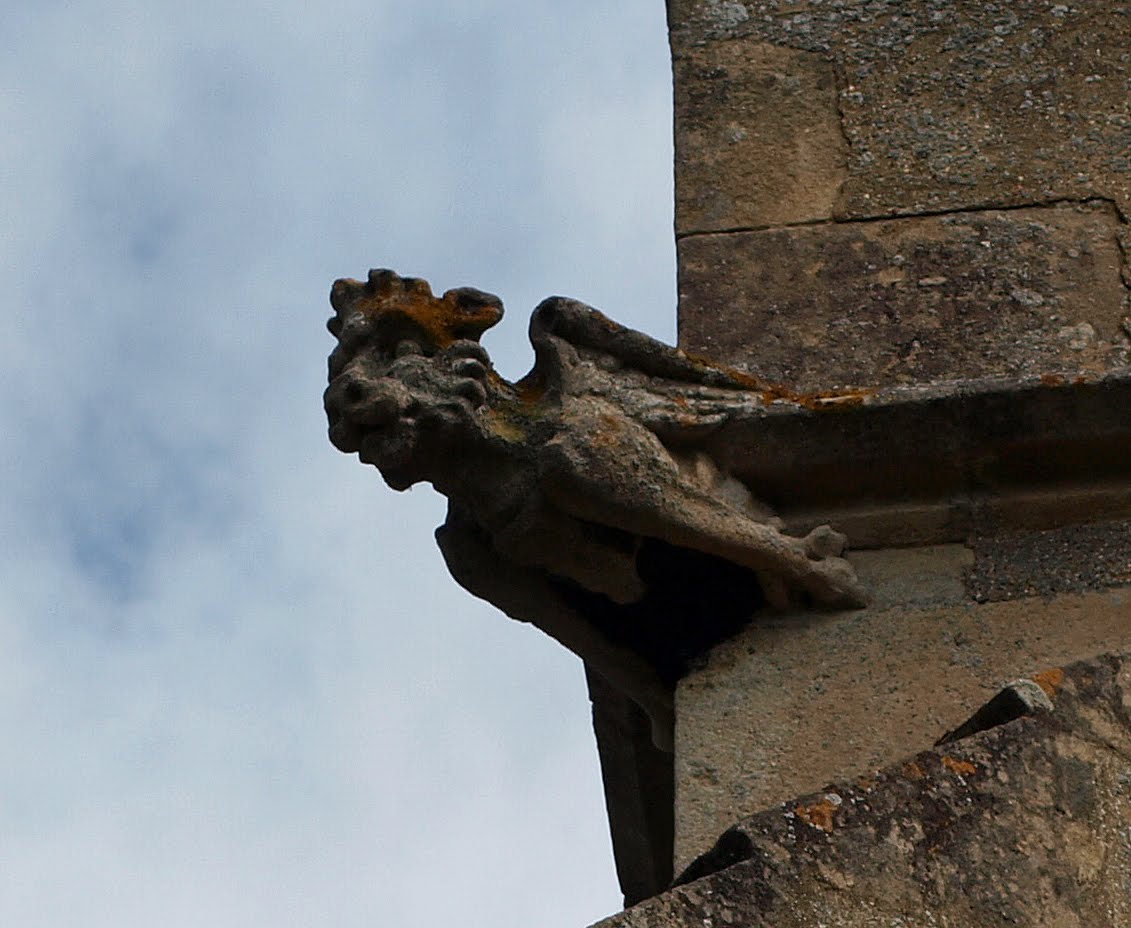
in their day that the pelicans and leopards and lions in the porch and
at the priest's doorway were carved.
It
has happened in our own time that the church of Markshall close by has
been pulled down, many of its memorials being bricked up in the vaults,
and the oak choir-stalls, the reading desk, and the brass lectern were
brought to Coggeshall. Several memorials to members of the Honywood
family have been taken to Colchester and can be seen in the garden by
the Holly Trees Museum; they include one of Sir Thomas, who took a
leading part in the siege of Colchester and was brother-in-law to Sir
Harry Vane. Another of this family's monuments is now in the vestry here
at Coggeshall; it is that of Mrs Mary Honywood, a well-known 16th
century lady who lived to be 93 and died here, but was taken to Kent for
burial at Lenham. A banquet was given to her by 200 of her descendants,
and the gathering might have been much greater had transport been much
easier, for she had a descendant for every day in the year and two
over. She was a brave woman, with something of the spirit of Elizabeth
Fry, for she visited prisons in Mary Tudor's time.
In
a delightful pastoral scene on the other side of the Blackwater is a
perfect little chapel of the 13th century; we come to it by a brick
bridge which has been here 700 years, perhaps the oldest brick bridge in
the country. Dedicated to St Nicholas, patron saint of travellers, the
chapel stood at the gate of a monastery. It is of interest on its own
account and also for the small pink bricks forming the arches of the
windows, the piscina, and the sedilia; the bricks are also at the
threshold of the doorway where they are cut and shaped into a pattern.
These bricks are under two inches thick and are the earliest known in
England since Roman days; it is believed that they were made at Tylkell *
on the north boundary of the county.
Fading
away at the back of the sedilia in this little chapel is a consecration
cross marking the place where the bishop put his hand on the wall 700
years ago. It was because the chapel was used as a barn that it escaped
the fate of the great church of the abbey at the Dissolution. Not a
stone of that church remains to be seen, but its Norman foundations have
been traced and found to measure 70 yards long with a width of 80 feet
across the transepts.
A
group of farm buildings here is of very great interest. One dates from
about 1200 and has roof beams 400 years old; and there is a 13th century
wing connected by a two-storeyed corridor to a 16th century house built
from the ruins of the monastery. The columns and arches we come upon as
we wander through this quaint rambling house suggest that the old monks
were building for all time.
Long
after the monks had passed away there were four brave men at Coggeshall
who died for their faith. Thomas Hawkes told the cruel Bishop Bonner
that if he had a hundred bodies he would suffer them all to be torn in
pieces rather than deny his faith, and he was burned in the vicarage
field, raising his hands and clapping them together. With him were
burned Thomas Osmund, a fuller, and William Bamford and Nicholas
Chamberlain, two weavers. Another story of cruelty is suggested by an
entry in the parish register, which records the death, in 1699, of the
"Widow Common that was counted a witch." Several times had she been put
in the river to see if she would sink, and it is thought that this cruel
treatment was the cause of her death.
* Tilkey, adjoining Coggeshall, seems not to be another case, though it lies between Robin's
Brook and the Blackwater. Apparently, its name is a corruption of Tylkell, meaning Tile
kiln (see Beaumont, Hist. of Coggeshall, p. 113: 1890).
Flickr set.