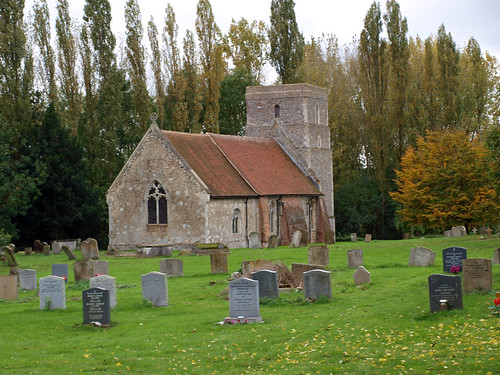
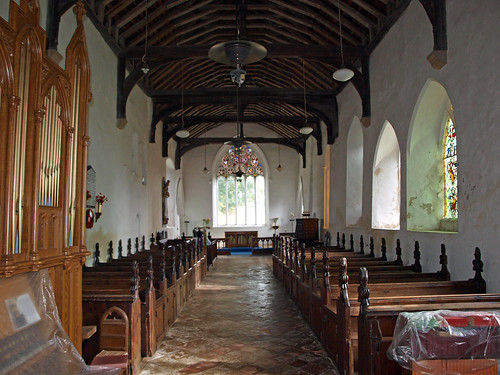
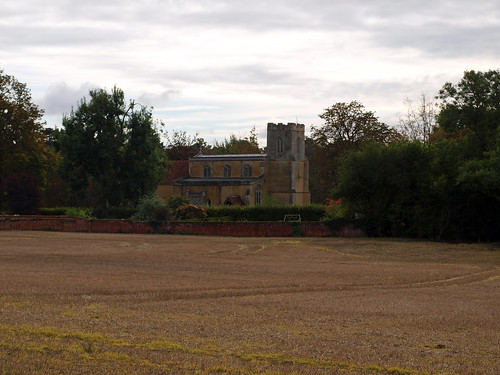
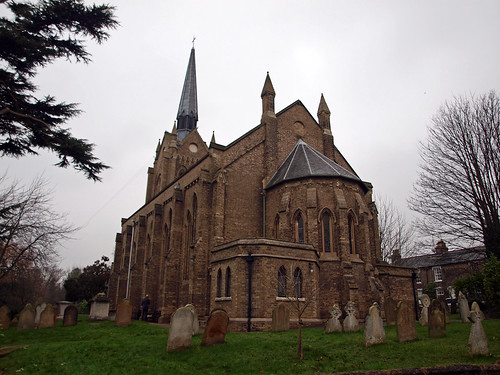
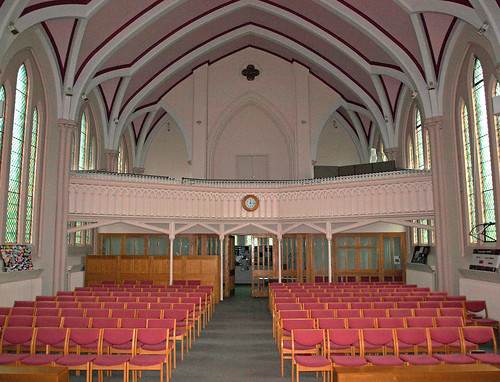
ST JOHN, St John’s Hill. 1844-5 by John M. Clark to a design by his friend, a local builder, Alfred Lockwood. Yellow brick, in the lancet style, with a W tower that turns higher up into a funny spire. The tower is square below, the spire octagonal, first with long open lancets, and only then steeply pyramidal. The side windows of the church are groups of three stepped lancets. Coved ceiling with ribs and bosses. Penetrations connect the windows with it. Canted-forward W gallery.
WOODBRIDGE. It is one of the most delightful small towns of this enchanting countryside, though as crowded with houses as its past is crowded with memories; its long street has hardly an inch to spare. The river bed has silted up since Woodbridge built ships for the Navy, but still the barges carry coal up the River Deben, and still there is much yachting here, and flourishing industries that have to do with ships.
It is one of the towns in which it is pleasant to walk about for the sake of old buildings, old inns, and old houses, and as we walk there come continually to mind the names of famous men who have walked before us here. This town has richly served its country, and the sights we see have been familiar to men whose names are known far and wide about the world. The National Trust is now the guardian of a beautiful site by the river that all Woodbridge people have loved, known as Kyson, and another delightful green space now belonging to all is Elmshurst Park, which has grown out of a beautiful private garden. Kyson was given to the nation by Mr R. C. Notcut, Elmhurst Park was presented to the town by Lord Woodbridge.
It is good to find that the Post Office has admirably done its duty to a fine town by joining hands with the Suffolk Preservation Society in preserving an ancient house. On the site of this 16th century house the new post office has been set up in such a way as to preserve the finest architectural features, the plaster ceilings in the rooms, and a Jacobean fireplace. It is an example the Post Oflice might well adopt in all our ancient towns.
In the same way there has been preserved through all its reconstructions since the 16th century the beauty of the Shire Hall, built on Market Hill by the benefactor of Woodbridge, Thomas Seckford. He was the great Elizabethan of this little town and will not be forgotten. His Shire Hall is Flemish in design, and he set under it the old Corn Exchange, originally open so that carts could be driven through, but now bricked in. His almshouses have been rebuilt, but they are one of the noble spectacles of the town, a delightful long row set on a hill, the home of 30 poor men who wear Thomas Seckford’s silver badges, a few married couples, and a few women living in a separate house to nurse them when they are ill.
A little after Thomas Seckford’s day the Friends Meeting House was built (in 1678) and it has a simple graveyard in which we find, among flowers and trees, a poet’s grave. It is in a lane down which the feet of a host of men have walked to pay tribute to Bernard Barton. He lived here about 40 years, son of a Quaker maltster, starting life in shopkeeping and becoming clerk to the local corn merchant, whose daughter he married. He lost his wife within a year and was left with one child, Lucy, who lived to become the wife of another and more famous poet, Edward FitzGerald - an unhappy marriage as it proved, for they were not congenial, and agreed to part. Barton lived on as a bank clerk after his wife’s death, and his poetry was the chief interest of his life. He was one of Charles Lamb’s best friends, and a consoling influence to him in the desperate crisis of his life. When he was 36 he had so many admirers of his poems that they presented him with £1200, and a few years before he died Sir Robert Peel invited him to dine, and got for him a Civil List pension. His quiet life was brightened by visits from Lamb and FitzGerald, and one of the pictures it is pleasant to think of in this country scene is of these poets walking on the river bank. When Barton died in 1849 his biography was written by the hand that wrote the immortal translation of Omar Khayyam.
There is another old graveyard in Woodbridge in which lies the father of one man of fame and the grandfather of another; he was William Lankester, father of Edwin Lankester, the pioneer of public health whose son was the great Ray Lankester, one of the most delightful scientific men of our time. In this graveyard now stands the Congregational Chapel.
Still another small graveyard with a curious interest we come upon in the tiny walled garden of the Bull Hotel, the old coaching inn on Market Hill where Tennyson stayed. Edward FitzGerald had a room in a house near it for 13 years, and the house has a tablet with his initials on it. Through the hotel yard we come to the grave of George Carlow, who owned the inn in 1738, when he died and was buried here. He left to the inn a small charity to distribute bread each year to the poor, and the bread is still distributed at his grave. On the stone is the doggerel from Shakespeare's grave, blessing the men who spare these stones and cursing them who move these bones.
The old Ship Inn near the quay has been turned into cottages, but the Bell and the Crown both remain. The Bell Inn, with its overhanging timbers, has kept from generation to generation what is the only thing of its kind in Suffolk, and one of very few left in England, the old steelyard for weighing hay, wool, and hides. The Crown Inn has memories of the days when Woodbridge was busy building ships for the Navy, and even of the days before that, for from it there went out into the world an English seaman of the days of Francis Drake, the little known John Fox, who set free a number of Christian captives at Alexandria. His father owned the Crown. In later days the inn was owned by Peter Pett, the man of whom we read much in Pepys, who succeeded him at the Admiralty. He was a Commissioner of the Navy in the bad old days, and it is said to have been his habit to pack the well-paid ofiices with his relations. Pepys called him a knave who deserved to be hanged for his neglect, and declared that he paid himself for the entertainment he gave the king, that he sold timber to the Navy under another name, and so on. He was charged with being the cause of a disaster at Chatham and was sent to the Tower, but the matter was dropped as it was apparently brought forward merely to make him a scapegoat. Andrew Marvell put the case in these four lines:
After this loss, to relish discontent,
Some one must be accused by Parliament;
All our miscarriages on Pett must fall;
His name alone seems fit to answer all.
The fine Woodbridge School has outgrown its old buildings, and was rehoused last century with laboratories, workshops, swimming baths, and boarding houses. The 17th century buildings are now used as a free library under the trusteeship of the Seckford Governors, and there has been discovered in one of the library windows in our own time a pane of glass of much historic interest. Mr V. B. Redstone, the librarian (a great authority on Suffolk’s history), discovered that certain old scratches on the pane were actually names upside down, and he found the names to be those of Francis Light and his schoolfriend James Lynn, who became a surgeon. The names were scratched on the pane about 1747, and in view of its curious interest the glass has now been taken out and preserved as a witness that here lived a Woodbridge schoolboy all too little known to fame.
Francis Light, who went out into the world from this old grammar school, is a striking figure in the annals of the British Empire, for he founded the city of Penang and was the father of the founder of the city of Adelaide. Penang has his statue and Adelaide has his son’s. Remarkable stories have been told about him, but the old story that he married the daughter of a king is not true. He found the Island of Penang a vast jungle of 100 square miles with only 50 people on it, and left it a prosperous place with 10,000 people, having watched over the interests of settlers and natives so that they mourned him as a father. The East India Company, for whom he secured the island, agreed to pay tribute “to last so long as the sun and moon shall give light.” This remarkable man was born at Dallinghoo, where we come upon him again.
On the school’s roll of fame is the honoured name of Edwin Lankester, the name of John Brinkley (Ireland’s first Astronomer Royal), and that of Baron Hatherley, Lord Chancellor. Edwin Lankester was plunged into poverty as a boy by the collapse of an investment in property, and he left school at 12 to become a watchmaker’s apprentice. He grew up to be a famous botanist and naturalist, but is chiefly remembered for his books on the microscope and his services to public health, which began when he was a coroner. He was shocked by some of the things he discovered, and made a sensation by insisting on proper evidence of the cause of death whatever it might cost. John Brinkley, the astronomer, was made a bishop by George the Fourth. Lord Chancellor Hatherley, brought up at his grandmother’s house in Woodbridge, lived through 80 years of last century, and before he was 30 was earning £1000 a year at the Bar. He was a good churchman and a good Liberal, and it fell to him to announce that Lord Rothschild should take his seat in the House of Lords. He was for more than 40 years a Sunday School teacher in the parish of St Margaret’s, Westminster.
Woodbridge has an interest, as we have seen, in the Australian city of Adelaide which was founded by Sir Francis Light’s son William, and Australia has another town founded by a Woodbridge boy, for George Miles, emigrating from here about the middle of last century, founded a settlement and named it after his own town. There should also be remembered in any description of Woodbridge the well known Suffolk artist Thomas Churchyard, a solicitor by profession but a painter of much skill, a friend of Edward FitzGerald, and often mentioned in his letters. Though FitzGerald himself is perhaps the most famous man who has been familiar in these streets, he has no memorial except his initials on the house where he lived on Market Hill, and the house called Little Grange, in which he lived after that; we come upon him at Boulge, where he lies. We talked in a shop at Woodbridge to two ladies whose grandmother had been housekeeper to FitzGerald, and had often told them of the strange figure walking about with a wide hat and a flowing cloak. It was while he was living on Market Hill that Tennyson came to see him, and it would seem that the meat for dinner was tough, and that FitzGerald was crochety.
We have yet to come to the finest building in Woodbridge, which is, of course, the 15th century church of St Mary, set on a hill and built of black flints, with a tower 108 feet high. The walls of the tower are neatly built, the flints forming designs, the corners crowned with filials and weathercocks. Over the porch are set in niches three figures of the Madonna, St Anne, and St Cecilia, all with crosses, and in the spandrels of the doorway is St Michael with the dragon. Among the fine treasures within are fragments of John Albrede’s 15th century screen still in their place, and 14 panels of the screen are preserved with traces of portraits of saints fading away on them. The marks of a lost brass which had two figures on it suggest that the brass may have been in memory of John Albrede and his wife. A brass of a child’s figure is to John Shorlond, a boy of seven who died in the last years of Queen Elizabeth, and there is a brass tablet to John Sayre, who died in the last year of Shakespeare’s life, and has in his epitaph this touch of humour:
Reader, thou shalt find
Heaven takes the best, still leaves the worst behind.
A monument to Jeffrey Pitman, fashioned in marble and painted and gilded, has five kneeling Elizabethans wearing great rulfs. Pitman was a local tanner who became Sheriff of Suffolk in the time of James the First, and was a liberal benefactor of the town. By his tomb hang two old helmets about 400 years old.
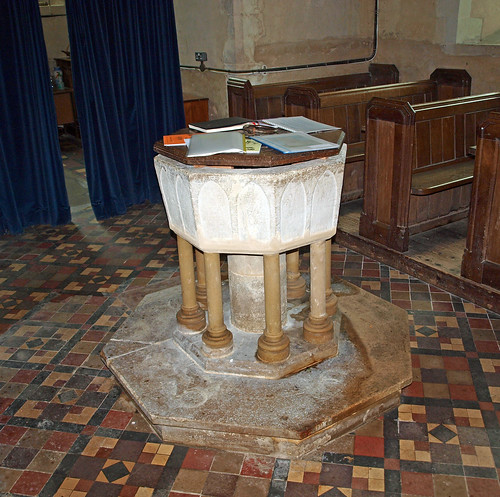
The lovely font has been one of the best in Suffolk, but has lost the colour given to it in the 15th century. Its carvings represent the Seven Sacraments, and one of the panels shows an imp, who is supposed to be fleeing through the door of the church porch; the font also has a carving of the Crucifixion, and on its shaft is a pot of lilies, symbol of the Madonna. It is in this church that the good Thomas Seckford lies, but this noble benefactor of the town has no sculptured splendour to preserve his name. He needs it not. If we seek his monument we look around - at his Shire Hall, his almshouses, and at the beautiful Woodbridge Abbey, now a private house in the old monastic grounds near the church, and still with some of its Tudor structure unspoilt since the Seckford family owned it.
Woodbridge has known more famous men, but none who served the town so well as Thomas Seckford. He was a lawyer and member of Parliament for Ipswich in Queen Elizabeth’s day, and he helped William Harrison with a book on the rivers and streams of England, a dream which has not yet been properly fulfilled, for not even the Government of this country has a list of its rivers; there is no complete book on them in existence. A more notable service still did Thomas Seckford render to this country, for to his generosity we owe the work of Christopher Saxton, who made the first proper maps of England. His was the first map survey of our counties, and it is to Thomas Seckford that we are indebted for them, for Saxton was his servant and Seckford paid for the maps, which took five years to make, and were dedicated to Queen Elizabeth.
It was here at Woodbridge that we came upon what we must regard as one of the most sacred and astonishing things we have seen in all our tour of England, the head of Oliver Cromwell.
Cromwell ’s Head
IT is an almost incredible spectacle with the hair still clinging to it, with teeth still there, with the forehead we are familiar with (even with the marks of the wart), and we are indebted to Canon Wilkinson for allowing us to see this astonishing relic of our greatest man of action. We found it wrapt in silk, enclosed in many outer wrappings, and kept in a box, from which it was taken so that we might hold it in our hands and look at this uncanny thing, and say, Alas, poor Cromwell! where be your great orations, your thunderings, which were wont to set kings and parliaments and armies in a roar?
By an act of revenge unthinkable to us now the body of Cromwell was dragged from its grave among our kings and hanged at Tyburn, and the head was stuck with a spike through the skull on Westminster Hall, where it stayed for 25 years, until at last it was blown down into the road by an angry wind, picked up by a sentry or a passer-by, and long kept in concealment, for a placard was issued for its recovery, and the finder apparently feared he would be blamed. Eventually it was sold to a member of the Russell family into which Cromwell’s youngest daughter had married, and after this the record tells that the head passed into the possession of an actor who, being in need of money, exhibited it, and finally sold it for exhibition to James Cox, a jeweller in Shoe Lane, who showed it for a time and then sold it to a syndicate of three people. The last survivor of the three was a lady, who, becoming superstitious about her gruesome property, first placed it in the custody of her doctor, Dr Josiah Henry Wilkinson, living at Shortlands in Kent, and then gave it to him. Mr Wilkinson drew up a detailed history of what had happened to the head between the time it was at Westminster and when it reached him. From him it has descended through generations of Wilkinsons to Canon Horace Wilkinson who showed it to us.
We do not think there can be any reasonable doubt that it is the head of the Protector. It has been subjected to every enquiry possible, and has been scientifically examined by Dr Karl Pearson and Dr G. M. Morant, who have applied every known test, and after every possible measurement and comparison with masks and portraits, and every investigation of associated circumstances, have come to the conclusion that it is morally certain that the head is the actual head of Cromwell. These are the last words of their report, which is accompanied by 100 plates:
We started this enquiry in an agnostic frame of mind, tinged only by scepticism as to whether the positive statements made in the past were not based solely on impressions unjustified by any attempt at a scientific investigation. We finish our enquiry with the conclusion that it is a moral certainty drawn from the circumstantial evidence that the Wilkinson head is the genuine head of Oliver Cromwell, Protector of the Commonwealth.
In our grand tour of England we have been in the bare attic of Newburgh Priory in Yorkshire, where it is believed the body of Cromwell was taken by his daughter Lady Fauconberg. It is supposed that the body was walled up in what is still called Cromwell’s room, but the wall has never been opened. If it should be true that the body is there, the nation has now the opportunity for a national act of atonement which will restore the Protector to the Abbey, and it is difficult to conceive a more impressive spectacle than the national burial of our hero with the fame and glory of nearly three centuries heaped upon his name.
It is one of the towns in which it is pleasant to walk about for the sake of old buildings, old inns, and old houses, and as we walk there come continually to mind the names of famous men who have walked before us here. This town has richly served its country, and the sights we see have been familiar to men whose names are known far and wide about the world. The National Trust is now the guardian of a beautiful site by the river that all Woodbridge people have loved, known as Kyson, and another delightful green space now belonging to all is Elmshurst Park, which has grown out of a beautiful private garden. Kyson was given to the nation by Mr R. C. Notcut, Elmhurst Park was presented to the town by Lord Woodbridge.
It is good to find that the Post Office has admirably done its duty to a fine town by joining hands with the Suffolk Preservation Society in preserving an ancient house. On the site of this 16th century house the new post office has been set up in such a way as to preserve the finest architectural features, the plaster ceilings in the rooms, and a Jacobean fireplace. It is an example the Post Oflice might well adopt in all our ancient towns.
In the same way there has been preserved through all its reconstructions since the 16th century the beauty of the Shire Hall, built on Market Hill by the benefactor of Woodbridge, Thomas Seckford. He was the great Elizabethan of this little town and will not be forgotten. His Shire Hall is Flemish in design, and he set under it the old Corn Exchange, originally open so that carts could be driven through, but now bricked in. His almshouses have been rebuilt, but they are one of the noble spectacles of the town, a delightful long row set on a hill, the home of 30 poor men who wear Thomas Seckford’s silver badges, a few married couples, and a few women living in a separate house to nurse them when they are ill.
A little after Thomas Seckford’s day the Friends Meeting House was built (in 1678) and it has a simple graveyard in which we find, among flowers and trees, a poet’s grave. It is in a lane down which the feet of a host of men have walked to pay tribute to Bernard Barton. He lived here about 40 years, son of a Quaker maltster, starting life in shopkeeping and becoming clerk to the local corn merchant, whose daughter he married. He lost his wife within a year and was left with one child, Lucy, who lived to become the wife of another and more famous poet, Edward FitzGerald - an unhappy marriage as it proved, for they were not congenial, and agreed to part. Barton lived on as a bank clerk after his wife’s death, and his poetry was the chief interest of his life. He was one of Charles Lamb’s best friends, and a consoling influence to him in the desperate crisis of his life. When he was 36 he had so many admirers of his poems that they presented him with £1200, and a few years before he died Sir Robert Peel invited him to dine, and got for him a Civil List pension. His quiet life was brightened by visits from Lamb and FitzGerald, and one of the pictures it is pleasant to think of in this country scene is of these poets walking on the river bank. When Barton died in 1849 his biography was written by the hand that wrote the immortal translation of Omar Khayyam.
There is another old graveyard in Woodbridge in which lies the father of one man of fame and the grandfather of another; he was William Lankester, father of Edwin Lankester, the pioneer of public health whose son was the great Ray Lankester, one of the most delightful scientific men of our time. In this graveyard now stands the Congregational Chapel.
Still another small graveyard with a curious interest we come upon in the tiny walled garden of the Bull Hotel, the old coaching inn on Market Hill where Tennyson stayed. Edward FitzGerald had a room in a house near it for 13 years, and the house has a tablet with his initials on it. Through the hotel yard we come to the grave of George Carlow, who owned the inn in 1738, when he died and was buried here. He left to the inn a small charity to distribute bread each year to the poor, and the bread is still distributed at his grave. On the stone is the doggerel from Shakespeare's grave, blessing the men who spare these stones and cursing them who move these bones.
The old Ship Inn near the quay has been turned into cottages, but the Bell and the Crown both remain. The Bell Inn, with its overhanging timbers, has kept from generation to generation what is the only thing of its kind in Suffolk, and one of very few left in England, the old steelyard for weighing hay, wool, and hides. The Crown Inn has memories of the days when Woodbridge was busy building ships for the Navy, and even of the days before that, for from it there went out into the world an English seaman of the days of Francis Drake, the little known John Fox, who set free a number of Christian captives at Alexandria. His father owned the Crown. In later days the inn was owned by Peter Pett, the man of whom we read much in Pepys, who succeeded him at the Admiralty. He was a Commissioner of the Navy in the bad old days, and it is said to have been his habit to pack the well-paid ofiices with his relations. Pepys called him a knave who deserved to be hanged for his neglect, and declared that he paid himself for the entertainment he gave the king, that he sold timber to the Navy under another name, and so on. He was charged with being the cause of a disaster at Chatham and was sent to the Tower, but the matter was dropped as it was apparently brought forward merely to make him a scapegoat. Andrew Marvell put the case in these four lines:
After this loss, to relish discontent,
Some one must be accused by Parliament;
All our miscarriages on Pett must fall;
His name alone seems fit to answer all.
The fine Woodbridge School has outgrown its old buildings, and was rehoused last century with laboratories, workshops, swimming baths, and boarding houses. The 17th century buildings are now used as a free library under the trusteeship of the Seckford Governors, and there has been discovered in one of the library windows in our own time a pane of glass of much historic interest. Mr V. B. Redstone, the librarian (a great authority on Suffolk’s history), discovered that certain old scratches on the pane were actually names upside down, and he found the names to be those of Francis Light and his schoolfriend James Lynn, who became a surgeon. The names were scratched on the pane about 1747, and in view of its curious interest the glass has now been taken out and preserved as a witness that here lived a Woodbridge schoolboy all too little known to fame.
Francis Light, who went out into the world from this old grammar school, is a striking figure in the annals of the British Empire, for he founded the city of Penang and was the father of the founder of the city of Adelaide. Penang has his statue and Adelaide has his son’s. Remarkable stories have been told about him, but the old story that he married the daughter of a king is not true. He found the Island of Penang a vast jungle of 100 square miles with only 50 people on it, and left it a prosperous place with 10,000 people, having watched over the interests of settlers and natives so that they mourned him as a father. The East India Company, for whom he secured the island, agreed to pay tribute “to last so long as the sun and moon shall give light.” This remarkable man was born at Dallinghoo, where we come upon him again.
On the school’s roll of fame is the honoured name of Edwin Lankester, the name of John Brinkley (Ireland’s first Astronomer Royal), and that of Baron Hatherley, Lord Chancellor. Edwin Lankester was plunged into poverty as a boy by the collapse of an investment in property, and he left school at 12 to become a watchmaker’s apprentice. He grew up to be a famous botanist and naturalist, but is chiefly remembered for his books on the microscope and his services to public health, which began when he was a coroner. He was shocked by some of the things he discovered, and made a sensation by insisting on proper evidence of the cause of death whatever it might cost. John Brinkley, the astronomer, was made a bishop by George the Fourth. Lord Chancellor Hatherley, brought up at his grandmother’s house in Woodbridge, lived through 80 years of last century, and before he was 30 was earning £1000 a year at the Bar. He was a good churchman and a good Liberal, and it fell to him to announce that Lord Rothschild should take his seat in the House of Lords. He was for more than 40 years a Sunday School teacher in the parish of St Margaret’s, Westminster.
Woodbridge has an interest, as we have seen, in the Australian city of Adelaide which was founded by Sir Francis Light’s son William, and Australia has another town founded by a Woodbridge boy, for George Miles, emigrating from here about the middle of last century, founded a settlement and named it after his own town. There should also be remembered in any description of Woodbridge the well known Suffolk artist Thomas Churchyard, a solicitor by profession but a painter of much skill, a friend of Edward FitzGerald, and often mentioned in his letters. Though FitzGerald himself is perhaps the most famous man who has been familiar in these streets, he has no memorial except his initials on the house where he lived on Market Hill, and the house called Little Grange, in which he lived after that; we come upon him at Boulge, where he lies. We talked in a shop at Woodbridge to two ladies whose grandmother had been housekeeper to FitzGerald, and had often told them of the strange figure walking about with a wide hat and a flowing cloak. It was while he was living on Market Hill that Tennyson came to see him, and it would seem that the meat for dinner was tough, and that FitzGerald was crochety.
We have yet to come to the finest building in Woodbridge, which is, of course, the 15th century church of St Mary, set on a hill and built of black flints, with a tower 108 feet high. The walls of the tower are neatly built, the flints forming designs, the corners crowned with filials and weathercocks. Over the porch are set in niches three figures of the Madonna, St Anne, and St Cecilia, all with crosses, and in the spandrels of the doorway is St Michael with the dragon. Among the fine treasures within are fragments of John Albrede’s 15th century screen still in their place, and 14 panels of the screen are preserved with traces of portraits of saints fading away on them. The marks of a lost brass which had two figures on it suggest that the brass may have been in memory of John Albrede and his wife. A brass of a child’s figure is to John Shorlond, a boy of seven who died in the last years of Queen Elizabeth, and there is a brass tablet to John Sayre, who died in the last year of Shakespeare’s life, and has in his epitaph this touch of humour:
Reader, thou shalt find
Heaven takes the best, still leaves the worst behind.
A monument to Jeffrey Pitman, fashioned in marble and painted and gilded, has five kneeling Elizabethans wearing great rulfs. Pitman was a local tanner who became Sheriff of Suffolk in the time of James the First, and was a liberal benefactor of the town. By his tomb hang two old helmets about 400 years old.
The lovely font has been one of the best in Suffolk, but has lost the colour given to it in the 15th century. Its carvings represent the Seven Sacraments, and one of the panels shows an imp, who is supposed to be fleeing through the door of the church porch; the font also has a carving of the Crucifixion, and on its shaft is a pot of lilies, symbol of the Madonna. It is in this church that the good Thomas Seckford lies, but this noble benefactor of the town has no sculptured splendour to preserve his name. He needs it not. If we seek his monument we look around - at his Shire Hall, his almshouses, and at the beautiful Woodbridge Abbey, now a private house in the old monastic grounds near the church, and still with some of its Tudor structure unspoilt since the Seckford family owned it.
Woodbridge has known more famous men, but none who served the town so well as Thomas Seckford. He was a lawyer and member of Parliament for Ipswich in Queen Elizabeth’s day, and he helped William Harrison with a book on the rivers and streams of England, a dream which has not yet been properly fulfilled, for not even the Government of this country has a list of its rivers; there is no complete book on them in existence. A more notable service still did Thomas Seckford render to this country, for to his generosity we owe the work of Christopher Saxton, who made the first proper maps of England. His was the first map survey of our counties, and it is to Thomas Seckford that we are indebted for them, for Saxton was his servant and Seckford paid for the maps, which took five years to make, and were dedicated to Queen Elizabeth.
It was here at Woodbridge that we came upon what we must regard as one of the most sacred and astonishing things we have seen in all our tour of England, the head of Oliver Cromwell.
Cromwell ’s Head
IT is an almost incredible spectacle with the hair still clinging to it, with teeth still there, with the forehead we are familiar with (even with the marks of the wart), and we are indebted to Canon Wilkinson for allowing us to see this astonishing relic of our greatest man of action. We found it wrapt in silk, enclosed in many outer wrappings, and kept in a box, from which it was taken so that we might hold it in our hands and look at this uncanny thing, and say, Alas, poor Cromwell! where be your great orations, your thunderings, which were wont to set kings and parliaments and armies in a roar?
By an act of revenge unthinkable to us now the body of Cromwell was dragged from its grave among our kings and hanged at Tyburn, and the head was stuck with a spike through the skull on Westminster Hall, where it stayed for 25 years, until at last it was blown down into the road by an angry wind, picked up by a sentry or a passer-by, and long kept in concealment, for a placard was issued for its recovery, and the finder apparently feared he would be blamed. Eventually it was sold to a member of the Russell family into which Cromwell’s youngest daughter had married, and after this the record tells that the head passed into the possession of an actor who, being in need of money, exhibited it, and finally sold it for exhibition to James Cox, a jeweller in Shoe Lane, who showed it for a time and then sold it to a syndicate of three people. The last survivor of the three was a lady, who, becoming superstitious about her gruesome property, first placed it in the custody of her doctor, Dr Josiah Henry Wilkinson, living at Shortlands in Kent, and then gave it to him. Mr Wilkinson drew up a detailed history of what had happened to the head between the time it was at Westminster and when it reached him. From him it has descended through generations of Wilkinsons to Canon Horace Wilkinson who showed it to us.
We do not think there can be any reasonable doubt that it is the head of the Protector. It has been subjected to every enquiry possible, and has been scientifically examined by Dr Karl Pearson and Dr G. M. Morant, who have applied every known test, and after every possible measurement and comparison with masks and portraits, and every investigation of associated circumstances, have come to the conclusion that it is morally certain that the head is the actual head of Cromwell. These are the last words of their report, which is accompanied by 100 plates:
We started this enquiry in an agnostic frame of mind, tinged only by scepticism as to whether the positive statements made in the past were not based solely on impressions unjustified by any attempt at a scientific investigation. We finish our enquiry with the conclusion that it is a moral certainty drawn from the circumstantial evidence that the Wilkinson head is the genuine head of Oliver Cromwell, Protector of the Commonwealth.
In our grand tour of England we have been in the bare attic of Newburgh Priory in Yorkshire, where it is believed the body of Cromwell was taken by his daughter Lady Fauconberg. It is supposed that the body was walled up in what is still called Cromwell’s room, but the wall has never been opened. If it should be true that the body is there, the nation has now the opportunity for a national act of atonement which will restore the Protector to the Abbey, and it is difficult to conceive a more impressive spectacle than the national burial of our hero with the fame and glory of nearly three centuries heaped upon his name.