Showing posts with label St Mary the Virgin. Show all posts

Monday, 17 May 2010

Debden, Essex

St Mary the Virgin is truly stunning not least because you have no idea what to expect until you get out of your car! It is secluded from the village and reached via a narrow lane; surrounded by trees it is practically invisible until the last minute. The church dates from the 13th century with major , to my, untrained eye, sympathetic, renovations in the 18th.

ST MARY THE VIRGIN AND ALL SAINTS. The interest of this church is connected with R. M. T. Chiswell who added the E chapel in 1793 and the Font in 1786. The church itself has C13 arcades of four bays with circular piers with moulded capitals and moulded arches. Only on the S side the two first capitals are enriched by upright leaves. The S aisle windows are Dec; C14 also the S porch. The W side has no tower but a front design which looks the idea of Gothic which the period about 1800 had. So it no doubt also belongs to Mr Chiswell’s time. To the same time the pinnacles must be attributed. For his E chapel Mr Chiswell got John Carter, the celebrated antiquary, to provide the design. It is an octagonal structure on the pattern of such a chapter house as York, connected with the church by a broad passage. The material is white brick, and all the detail of tracery outside (E window) and inside is of papery thinness. The chapel has a ribbed plaster vault, the passage timber arches with thin pendants. Inside the chapel is the elaborate MONUMENT of R. M. T. Chiswell  d. 1797, a tomb-chest with foiled decoration in the style of the C15 under a sumptuous arch in the style of c. 1300. Two other minor MONUMENTS in the current idiom of Late Georgian epitaphs are by King of Bath. - Large monument to William Burhill, d. 1703. It is signed Thorne (R. Gunnis). - FONT. 1789 3 octagonal of Coade stone in an elaborate and crisp Neo-Perp, with foiled panels; against the stem minute figures. The design was provided by R. Holland. Of Coade stone also the two medallions with quatrefoils outside the E chapel. - STAINED GLASS. In one S window heraldic glass evidently also late C18. The church stands all on its own in the beautifully landscaped grounds by the made lake. The Hall (by Holland, 1796) was demolished  1936.


Chiswell Arms

 Muilman Arms

Trench Arms

Exterior arms

Exterior arms

Exterior arms

Holland Memorial

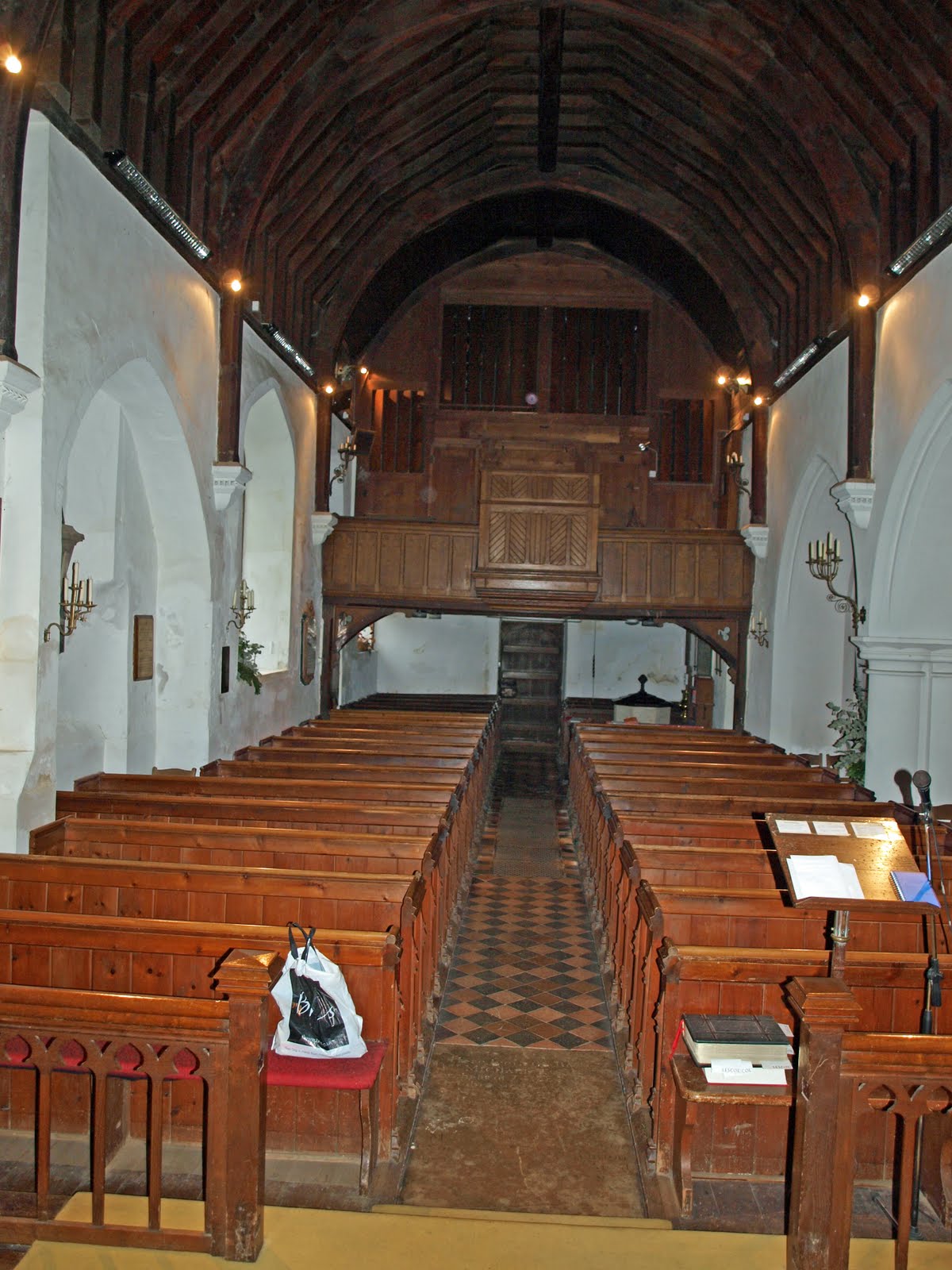
Sadly the interior is a disappointment and doesn't live up to the, frankly, stunning exterior and wonderful setting - despite this I'm placing it as number two behind Saffron Walden and Thaxted as joint number one in North Essex.

And it has loads of snowdrops - which has to be good.


Arthur Mee:

DEBDEN. It is rich in old houses and farms, some Tudor and some 17th century. Scot's Farm at Hamperden End has in one of its rooms a lovely frieze with lions' faces. Mole Hall, its moat still wet, has three original chimneys, a fine barn, and two timber-framed outhouses with oak staircases. Amberden Hall, some way off, also has a moat; and New Amberden Hall, for all its name, is 17th century. The great house is Debden Hall, which stands by a lake in a splendid park of 200 acres; it was built in the 18th century, and is said to be the successor of one that stood here in the Con­queror's day.


The church of this beautiful village is in a perfect setting, reached through a field rich in Spanish chestnuts. It has seen many changes, the 18th century having given it a new chancel and bell-turret; but it has kept a 14th century doorway by which we come to a nave with 13th century arcades. One of the aisles is 15th century; the other, with its porch, is a hundred years older. There is a Tudor chest bound with iron, a window with the Chiswell arms, and an elaborate modern altar tomb to Trench Chiswell, who rebuilt the chancel after it had been destroyed by the falling of the old tower. A tablet tells of Harold Fisher, a Haileybury boy who helped to defend Ladysmith, won the DSO, and lived on to die for us in the Great War.
Flickr set.

Tuesday, 11 May 2010

Birchanger, Essex

Arthur Mee:

BIRCHANGER. Very impressive are the trees at the great house, a splendid clump of eight elms in a field, a lovely larch in the churchyard, and a superb cedar of Lebanon, 18 feet round the trunk. Birchanger Place has also a dovecot with plaster nests still on its walls. The church has lost the old round tower which would have made it one of a select little company of seven in Essex; but it has kept its Norman nave with two doorways, each with a tympanum, one carved with a horse. The chancel is a century younger, with four small lancet windows. We come in through one of the Norman doorways to see a 15th century font, seven benches as old, and a modern brass, interesting as being one of the first pictures of a soldier's khaki uniform on a memorial. It is to Jack Watney, a lad of 19 who fell in South Africa in 1901, and shows a figure in khaki in front of a machine-gun. The gravestone of a rector tells a moving little story of Advent Sunday in 1877, Walter Hatch had taken as his text the words "Come ye, and let us walk in the light of the Lord"; and only a few minutes later "God took him."

I was lucky when I visited as the church was locked, with no evidence of a keyholder, but a kind lady heard me trying the door and let me have a look around and take pictures. The exterior suffers from the loss of the tower (it also didn't help that it was overcast and mizzly) but the interior was interesting - the more so since it is normally inaccessible to the casual visitor!

St Mary the Virgin is one of the 250 Anglo-Saxon, or part Anglo-Saxon, churches that survive in Britain. It is built of flint rubble with dressings of limestone and clunch, and dates from the Saxo-Norman period (1000 to 1199). Birchanger may have had some kind of pre-conquest church but, due to re-building and alteration over the years what preceded St Mary is a matter for conjecture.

In the 1930's a 12th century south doorway was discovered, the internal arch was subsequently raised to accommodate the staircase to the organ gallery. Although similar in decoration to the west doorway it has additional foliage scrolls along the arch and a small carving high up in the tympanum depicting the Lamb of God, with cross flag of victory.

The interesting brass mentioned by Mee is to Lt Jack Southard Watney.He was killed in action at Tweefontein, in De Wet's attack on Christmas morning, 1901. He was the eldest son of Mrs Hattie Gilbey Watney of 24 Clanricarde Gardens,and of Ernest Watney. He was born in March 1882, and educated at St Paul's School and at Eton. He volunteered for active service in South Africa, and first served in the ranks of the Imperial Yeomanry. He was quickly promoted sergeant, and appointed to the 11th Battalion in June 1901, as machine gun commander, with the rank of Lieutenant in the army. In the action in which he fell he was in command of a maxim gun, and reported by Lord Kitchener to have been killed "while heading a charge". He died with all the men of his gun section around him either killed or wounded. Lieutenant Watney was buried at Tweefontein, and his name was inscribed on an obelisk, which has been erected there in memory of all those who fell in this action. He was buried near the battlefield but his remains were moved to Harrismith cemetery in 1958/9.


St Mary the Virgin

Aisle and Organ Gallery

Jack Southard Watney

 Is this graffiti and if so, is it a camel, a five legged horse or an excited stallion?


Window detail


Friday, 23 April 2010

Arkesden, Essex

St Mary the Virgin sits atop a hill (or what we in Essex call a hill) overlooking the heart of the village and whilst the church and its position are lovely it contains one of the most over restored monument I've yet seen.

A pretty, small village by a tiny stream.

ST MARY. Traces of a Norman round tower were found, when in 1855 the present W tower was built. At the same time the church was heavily restored. It consists of a C13 nave and a C13 chancel. Roofs, clerestory, and chancel arch belong to 1855. Inside, the S arcade has circular piers, the N arcade octagonal piers. Both have arches with two slight chamfers. So they must both be C13, and not too late. - PLATE. Cup of 1562; Paten of 1567. - MONUMENTS. Brass to a Knight, mid C15, the figure three feet long. - Effigy of a Priest, C15; in a very low two-bay recess in the chancel N wall. The recess has three broad piers with niches for figures. - Richard Cutte d. 1592 and wife. Large standing wall-monument with two recumbent effigies, and the children kneeling against arches on the front of the tomb-chest. The effigies under a heavy six-poster with odd short baluster-columns which have leaves growing up the lower thirds of their shafts. Straight top with obelisks and achievements. - John Withers d. 1692 and wife. Standing wall-monument with an excellent stone-relief of skulls and branches and higher up excellent busts of marble. It is a first-class work and has recently been convincingly attributed to Edward Pearce (cf. Great Canfield). 


Richard Cutte 1592


Arthur Mee:


Arkesden. It lies in a winding valley and has its share of the old farms and cottages which are the pride of Essex. From a little bridge guarded by an ancient elm its green slopes up to a churchyard with a peace memorial on a great boulder between two handsome pines. Higher still stands the church, which has a 15th century tower rising from the massive Norman foundations. The building has been much restored, but is chiefly 700 years old, with double lancets in the chancel, fine round pillars in the nave and an aisle added in 1500 by a wealthy London fishmonger. The font bowl is Norman and stands on low arches not quite so old. A piscina in one of the aisles has been supported by a grotesque head for 600 years.


But the great attraction here is in the ancient monuments. A solemn 15th century priest lies in his robes in the chancel, in a double recess divided by a pillar with a lovely niche. He may have come from Walden Abbey in Bedfordshire, to which this church belonged for nearly 200 years before the Reformation; we see the abbey arms in old glass in the tower. A brass portrait shows Richard Fox of 1439 in armour with his dog and beside him towers the Elizabethan monument of Richard Cutte, who lies with his wife under a rich canopy. His feet are on the heraldic beast of his crest and hers rest on a red dog, but the quaint feature of the tomb is its recesses at the sides, six of them with figures of children, all named.


A boy of the next generation in this family, son of another Richard Cutte, is known to history as John Cutts and shines in the glowing pages of Macauley as he shone on the battlefields of the Duke of Marlborough. He was born at Arkesden in 1661 and lived to be a great soldier. He fought Protestant battles wherever he had the chance and always, as Macauley says, as the bravest of the brave. He is a European figure and was the first to lead the attack at the Battle of Blenheim, his last battle. So much at ease was he in the hottest engagements that his men called him the Salamander and Macauley declared that he was unrivalled for bulldog courage, always the man for a forlorn hope. In peaceful life he made Steele his secretary and Steele dedicated his first book to him. Perhaps it is to the honour of this courageous man that he was himself the butt of Dean Swift's abuse. He died in Dublin and so is not among his ancestors in this village which gave him birth.

Just a century younger is a big monument to John Withers of the Middle Temple, with handsome busts of himself and his wife, by Roubiliac, A side chapel is in memory of Herbert Fearn who, in 1916, finished a ministry of 47 years. Rich glass above its little altar shows the Madonna, St Michael and St Alban.

The churchyard has kept some of its gravestones since the 17th century, one with a cherub and two skulls in foliage deeply carved.

Flickr set.