Tuesday, 10 November 2015

Cambridge Cemeteries

Ascension Parish Burial Ground

Hard to find due to the narrow lane off Huntingdon Road in the north west of the city, and a major roadworks upgrade ongoing when I visited, this is a well maintained, intimate cemetery. The BBC describes it as Britain's brainiest cemetery and I have to admit that while I noticed several Dons and other brainiacs I completely missed Ludwig Wittgenstein (probably because I'm not that much in to him).

It treads a very fine line along the "managed for nature, maintained for the populace" line striking, in my opinion, an almost perfect balance.

As I said small and intimate and a good start to the day.
Headstone

Histon Road Cemetery

Established in 1843 by the non-conformist community, Histon Road Cemetery was one of only three in England designed by the leading Victorian garden designer J C Loudon. Now closed, it is cared for by Cambridge City Council working closely with the Friends of Histon Road Cemetery. As one of the best preserved examples of Loudon’s work the Cemetery is English Heritage grade II* listed.

It's well maintained but somewhat dull but having said that I did enjoy the east side hodgepodge of headstones.
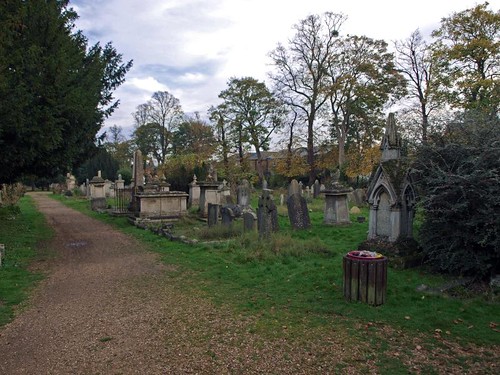
 Histon Road Cemetery (1)

Cambridge City Cemetery

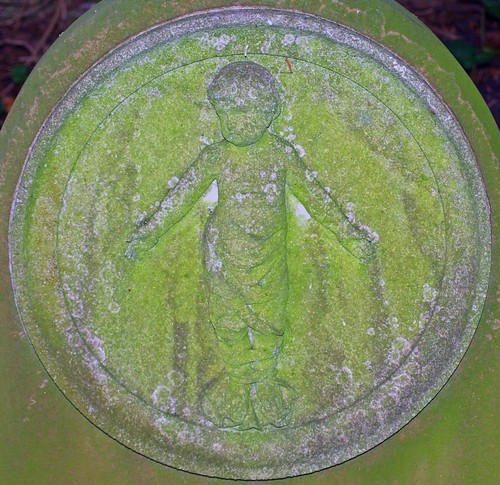
A municipal  burial ground with Jewish and Islam sections which brings a huge range of idiosyncratic headstones to the table. And then you come across the child plot - I stayed a while, prayed and walked away profoundly moved.

Whilst this is the burial ground for thousands of Cambridge ex-residents it is also the remembrance garden of  1024 WWI & II deaths - the largest CWGC site I'd seen to date and is a sight to remember.
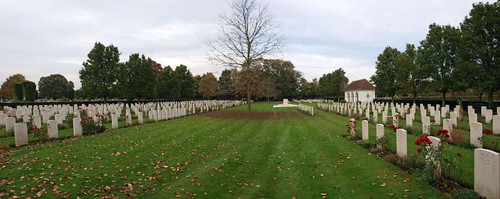
 CWGC Air Force plot (6a)

Mill Road Cemetery

Grade II listed site (and nine individually Grade II listed monuments) and managed for wildlife this is a fascinating, if dog shit covered, cemetery and a lovely green space even on a mizzly November day. Also the most informative cemetery I've visited both on site and on their brilliant website.

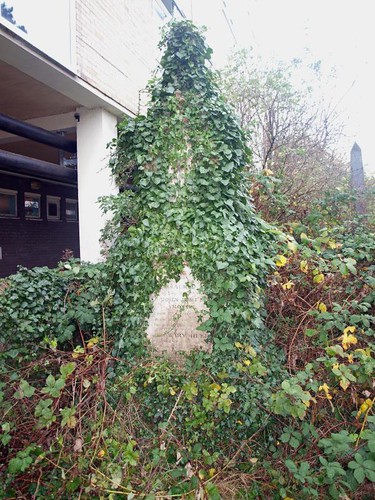
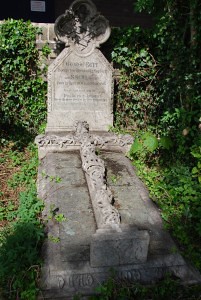
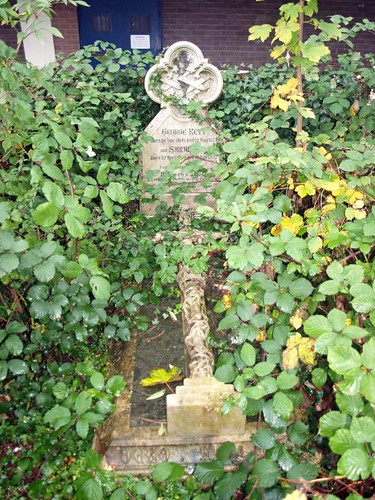
My one caveat is that management for wildlife seems to have taken precedence over care of listed monuments in some cases:

Then
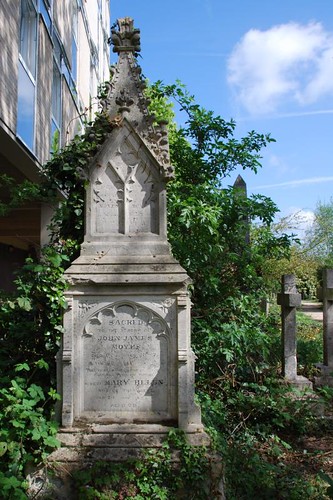
Moyes2

Now

Moyes family c1865 (1)

Then

George & Sarah Kett

Now

George Kett 1872 (2)

The American Cemetery

Not strictly a Cambridge Cemetery, it's in nearby Madingley, the Cambridge American Cemetery and Memorial site in England, 30.5 acres in total, was donated by the University of Cambridge. It lies on a slope with the west and south sides framed by woodland. The cemetery contains the remains of 3,812 of US military dead; 5,127 names are recorded on the Tablets of the Missing. Rosettes mark the names of those since recovered and identified. Most died in the Battle of the Atlantic or in the strategic air bombardment of northwest Europe.

From the flagpole platform near the main entrance, the great mall with its reflecting pools stretches eastward. It is from the mall that the wide, sweeping curve of the burial area across the lawn is best appreciated. Along the south side are the Tablets of the Missing, and at the far end is the memorial with a chapel, two huge military maps, stained glass windows bearing the state seals and military decorations, and a mosaic ceiling memorial honoring the dead of the air forces.
Just. Do. It.
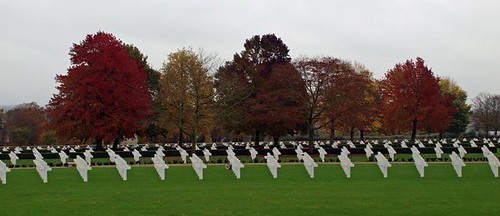
Lest we forget (12)

Monday, 19 October 2015

Little Downham, Cambridgeshire

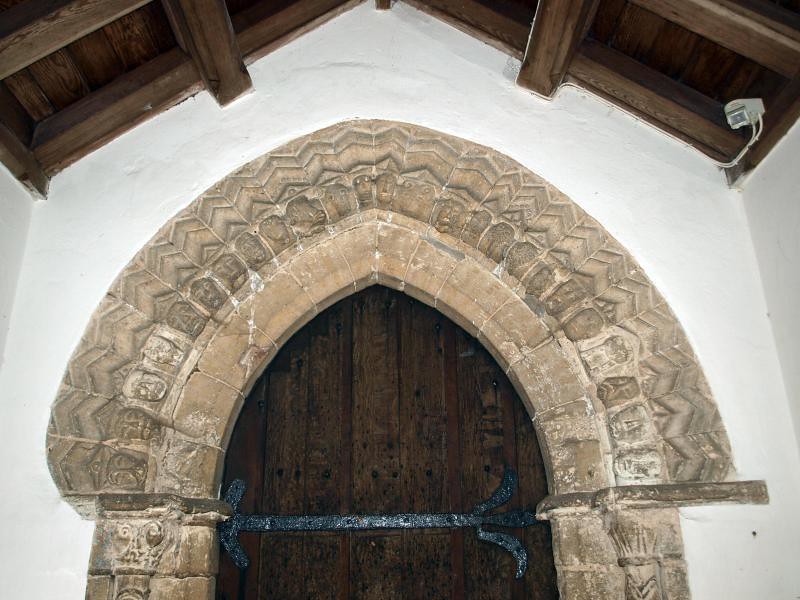
St Leonard is a small, intimate building set in a lovely churchyard with some good glass (including Geoffrey & Christopher Webb windows), a Norman south door and a massive GR royal arms. Whilst not a top ten church I really liked it.

ST LEONARD. The small W tower is Norman in its lowest stage, unbuttressed with tiny round-headed windows. Norman also the S doorway with spiral-grooved shafts (cf. Ely), a roll-moulding with, along it, twenty-six close-set faces of all sorts and sizes and an outer zigzag moulding. But the arch is pointed and the rest of the church is indeed essentially Transitional or earliest Gothic. The transition was no doubt gradual, and certain things which appear historical development to us may well have taken place at the same moment. The small tower arch towards the nave for instance is pointed. To its l. and r. higher up two small nave W windows of lancet shape. Lancets on the second and third stage of the tower (the bell-stage is C 19*), lancets at the W ends of the aisles, and a blocked lancet in the N wall of the N aisle. The arcades go well with these windows. They have alternating circular and octagonal piers with the plainest capitals and double-chamfered arches. In the C14 the chancel received new windows (E window renewed C19), and in the C15 the porch was added (rebuilt C19). The aisle windows are mostly Victorian. The church is largely of flint, the northernmost case of this material in the county. - FONT. Octagonal, Perp, with blank arches against the stem and the coving below the bowl and quatrefoils with rosettes on the sides of the bowl.

* But Cole in the mid C18 says: ‘Tower of white brick’ and shows buttresses with lower parts.

St Thomas (2)

S door (7)

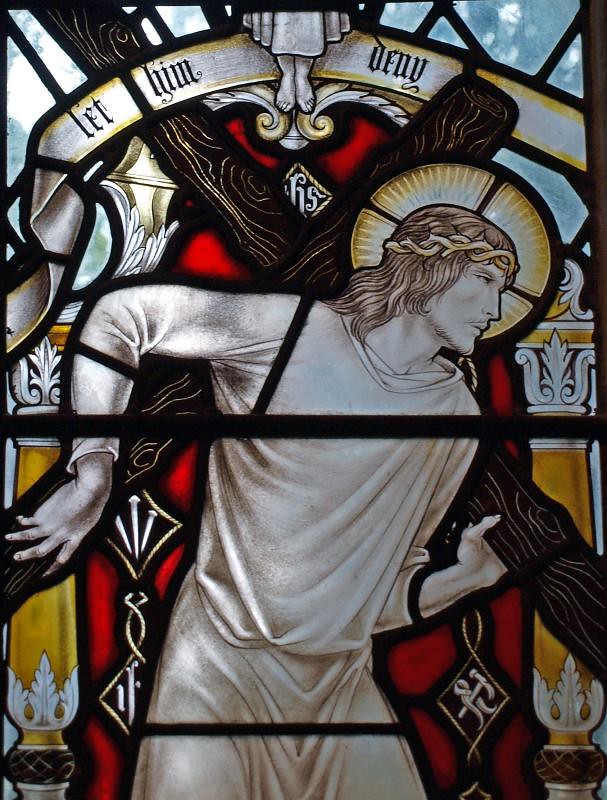
Geoffrey Webb Road to Gethsemane (4)

LITTLE DOWNHAM. Little only in name, this village has an ancient church at one end, the remains of a magnificent palace at the other, and Ely Cathedral within three miles.

The palace was built by Bishop Alcock of Ely at the end of the 15th century, and we found all that is left of it serving as storerooms for a farm; but we may see the great brick oven and a smaller one where the bishop’s bread was baked; we may look through his windows and stand under a carved archway through which passed more than one famous bishop, the last of them to a long imprisonment in the Tower. He was Matthew Wren, Sir Christopher’s uncle, who was arrested here, after Laud’s impeachment, as a supporter of the fallen archbishop; he was put in the Tower and languished there for 18 years. Long afterwards, being warned by Charles the Second as to his conduct, Wren answered in a moment of great boldness that he knew the way to the Tower.

Much of the church was already old when the palace was new. The small tower with its thick walls is mostly Norman, and best of all is the beautiful doorway in the south porch from the time when Norman ideas were changing to English. Its shafts and capitals and slightly pointed arch are a mass of crude carving, zigzags and faces and beaked animals (one of a two-headed cat), and in it hangs a noble old door with fleur-de-lys hinges.

It brings us into a plain clerestoried nave of the 13th century, with a simple arch leading into a 14th century chancel. By some of the windows are the heads of a king and a wimpled woman, a hideous dragon, and a graceless boy sticking out his tongue. The tall graceful font with a tapering bowl cut with roses is 500 years old; the fine chest cut with pomegranates is getting on for 400. We noticed that one rector, Thomas Jones, outspanned all the others on the list by serving for all but sixty years of the 18th century.

Friday, 7 August 2015

London, City - St Giles without Cripplegate

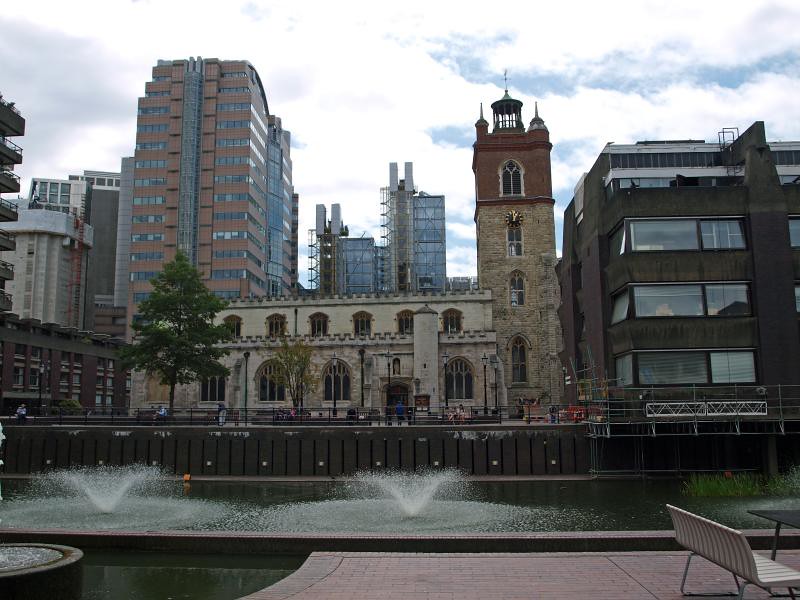
After St Clement, West Thurrock, St Giles (open and very welcoming) sits in one of the most bizarre settings I've yet come across. It's in the middle of the Barbican estate, a 1960s/70s housing estate and a prominent example of British brutalist architecture - it really is quite an extraordinary setting.

Whilst not the most exciting of interiors - it was extensively restored three times following fires in 1545, 1897 and in 1940 there was a direct hit on the north door in the summer and the following December the church was showered with so many incendiary bombs that even the cement caught alight - there is plenty of interest here. Given that only the shell, the arcade in the chancel, the outside walls and the tower survived the bombing this is a very sympathetic restoration.

Mee's entry records the pre-bombed church and is interesting as it shows what was lost to the incendiaries.

At the end of Monkwell Street is a passage opening to an avenue of trimmed planes in the churchyard of St Giles’s, Cripplegate.

Rahere the king’s jester built St Bartholomew’s and his friend Alfune built St Giles’s. That was in the reign of William Rufus, but the church as we see it has been twice rebuilt, and except for the base of the tower is mostly 400 years old. It must be for ever a place of pilgrimage for the English-speaking race.

Here one drab November day in 1674 they buried an old neighbour, giving him a “very decent interment according to his quality.” The little procession had come from a house not far away, with brother Christopher and two nephews, a few learned friends, and a “concourse of the vulgar” to say farewell to a blind old man in grey so long familiar in these streets. He was John Milton.

Here one summer’s day in 1620 there had come another small procession with a joyous purpose, for a young man from the country was marrying a merchant’s daughter from Essex; he was not yet 21, but was a man with great spirit, kneeling here in front of the altar with his bride, and his name was to ring round the world with that of the blind old man. He was Oliver Cromwell, and his bride was Elizabeth Bourchier. One day in the years that lay ahead an exiled king was to come back to his throne to find a paper at his Privy Council marked Old Mrs Cromwell - Noll’s Wife’s Petition.

This precious church was spared by the Great Fire, but it has suffered from other fires, for the City has always pressed closely round it, as the warehouses do still. It is plainly seen from Fore Street (the ancient way before the Wall), or from the churchyard, but the best view is from the vicar’s gate, where we see the tower with its fine 15th century base and its upper storey of 1684 with a wooden lantern and a fine musical peal of 12 bells which play hymns and songs every three hours.

This church with so much history has in its churchyard a visible monument of the earliest days of our history, a bastion of the Roman Wall with flowers and plants creeping out of its crevices. It is a thrilling sight. Sharing the churchyard with it is Milton’s statue, with these famous lines from Paradise Lost:

O spirit! What in me is dark
Illumine; what is low, raise and support,
That to the height of this great argument
I may assert Eternal Providence
And justify the ways of God to man.


On the pedestal are scenes in Comus and Paradise Lost. In the church is a tablet marking the grave of the poet; he lies with his father in the chancel. Near the tablet is his bust, by John Bacon.

The oldest monument that has escaped the fires of Cripplegate is that of Thomas Busbie, a rich cooper who died in 1575. His painted figure shows him in a black coat, his face full of benevolence, and his epitaph tells us that he gave the poor of Cripplegate every year four loads of the best charcoal and 40 dozen loaves.

Near him lies a man who died the year before the Armada came, before either Milton or Cromwell was born, leaving behind him the Book of Martyrs which was placed with the Bible in hundreds of churches, chained for safety. His name is on the north wall. John Foxe had saved his life by living abroad in the years of persecution, and though he might have held high oflice in the Church he lived in toil and privation, writing what he believed was true. It was his deepest conviction that religion had no place in it for cruel violence, a truth that was rarely seen in his day among any body of Christians in the land.

Here Lies Martin Frobisher

In that Tudor age they brought to this place another man who lives in history though his heart is buried far away in Plymouth; he was that plain old sailor Martin Frobisher, explorer of the North-West Passage, one of the most skilful of the men who shattered the Armada, and a hero after Queen Elizabeth’s own heart. His monument is in a dim corner of the south aisle, and has a relief of a sailing ship bristling with cannon. It was put here 300 years after the defeat of the Armada, and has on it the lines of Macaulay beginning, Attend! all ye who list to hear our noble England’s praise. On an ornate monument in the north aisle is a bust of Sir William Staines, Lord Mayor in 1800, in his chain of office.

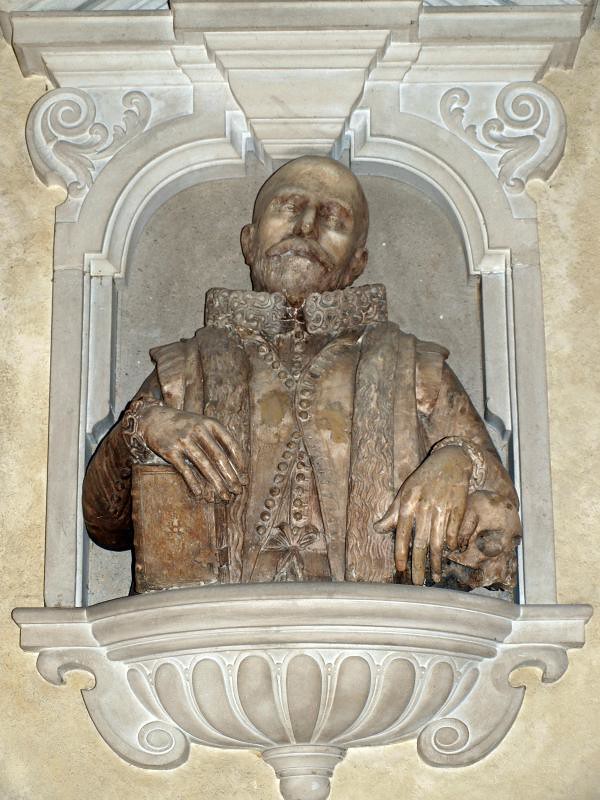
Here also lies John Speed, the Cheshire man who spent most of his days working as a tailor in London, but whose remarkable knowledge of history won for him the friendship of Fulke Greville. It was Fulke Greville who enabled him to take up the task of drawing maps of all the counties of England, and of writing their history “from Julius Caesar to King James.” He was the first man to summarise all the history that was known of his country. They laid him in this church in 1629; and here we see his figure, with a book in his right hand and his left on a skull, enclosed as in a cupboard. Near him are kneeling 17th century figures of Richard and Elizabeth Smith. An Elizabethan vintner, Roger Mason, is also here, engraved on a stone panel, kneeling with his wife and daughter.

The famous Lancelot Andrewes, who was vicar here before he became three times a bishop and one of the greatest spiritual forces in the life of the Church, is remembered with an inscription. He was one of the men who made the Authorised Version, and when he passed away in 1626 Archbishop Laud wrote in his diary: “About four o’clock in the morning died Lancelot Andrewes, the Great Light of the Christian Church.” Another vicar here was Samuel Annesley, whose daughter Susannah became the mother of John Wesley.

That is All

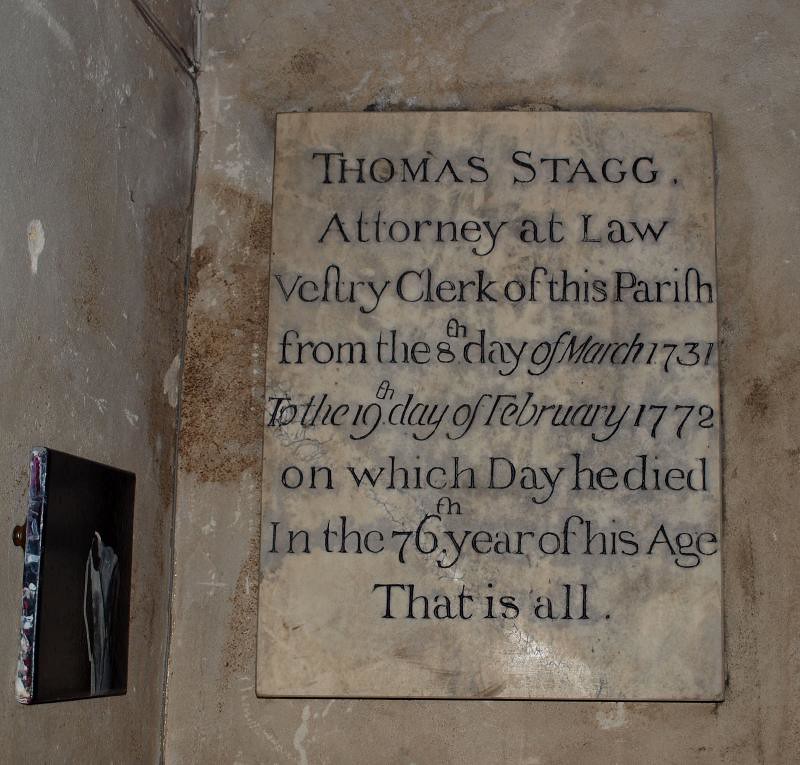
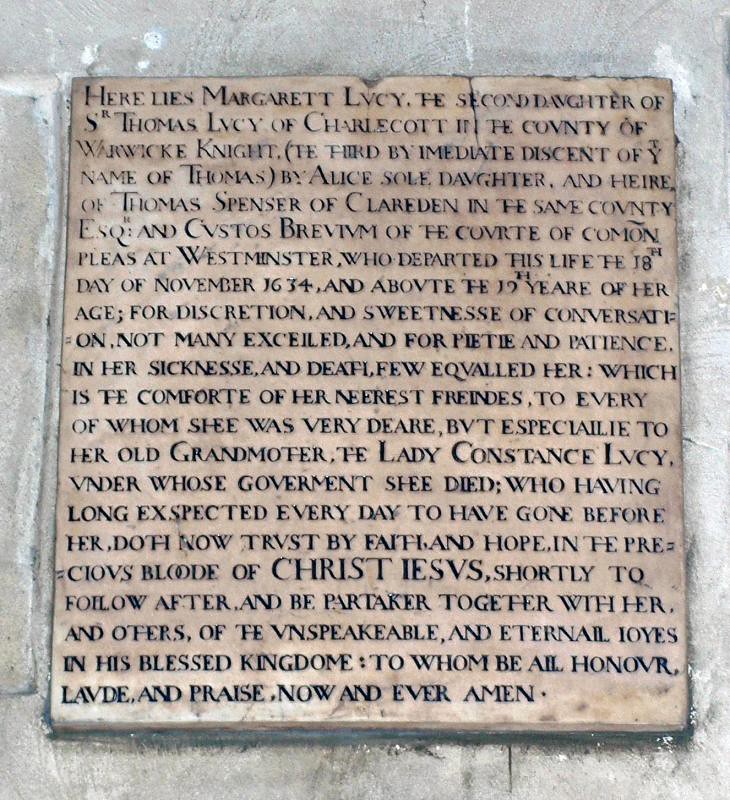
Over the north door is a fine marble monument to Edward Harvist, one of King James’s gunners, who is shown facing his wife across a prayer desk. Edmund Harrison, embroiderer to three Stuart kings, has a tablet saying he “left the troubles of this world” in the year of the Fire, and just below is a panel engraved with the kneeling figure of Charles Langlie, a Tudor brewer. In the north aisle is a curious and striking monument with a figure of a girl in a shroud rising from a coffin; it is thought she was a relative of Sir Thomas Lucy, Shakespeare’s Justice Shallow. On the south wall are little 17th century figures of Matthew and Anne Palmer, with five children. A monument by Thomas Banks shows Mrs Hands dying in the arms of her husband, a vicar here, and near this is the epitaph to Thomas Stagg, an 18th century vestry clerk, giving the date of his clerkship and his death, and adding, That is all. The church has other treasures worthy of notice. The altar, the balusters of the rails, the clock with the gilt figure of Time, the pulpit with festoons of fruit and flowers, the font cover with its gilded dome, and the lectern, are all early 18th century, and it is believed that some of this woodcarving is the work of the Richard Saunders who made Gog and Magog in the Guildhall. The fine oak reredos of 1704 has modern painted panels, and the north chapel has a 17th century reredos with carved angels and paintings of Moses and Aaron. Like the 18th century doors to the north lobby, it came from a lost church. Hidden under the reredos are tiles 600 years old.

The east window is oval, with some 18th century glass. A modern window with three panels of the Nativity is in memory of Edward Alleyn, the actor friend of Shakespeare and founder of Dulwich College. Two other famous names come into the church register: Holman Hunt, whose painting of the Light of the World is known everywhere, and who was baptised here; and Daniel Defoe, whose death is recorded here although he lies in Bunhill Fields. He lived close by in the Barbican, and it is thought his book on the Plague deals with this parish. During that awful year the number of burials in this churchyard reached 800 in a week.


St Giles (4)

Thomas Stagg 1772

John Speed 1629 (3)

Margaret Lucy 1634

A large church mostly of c. 1545-50, i.e. at the end of the medieval church-building tradition. Much restored in the late C19 and again by Godfrey Allen after severe bomb damage (reopened 1960). It now serves as the centrepiece of the Barbican Estate’s main open space. Overshadowed by massive concrete forms and paved right up to the walls, it looks in its situation by the lake almost as if dismantled and brought from elsewhere; but it also anchors the late C20 environment in the wider urban context - in part by marking the true ground level, something visitors to the Estate may find elusive - and in an older history.

The church is recorded as having been built by Aelmund the priest c. 1102-15. According to Stow, the former vicarage stood on the site of an earlier church further W, but this may only have been a wayside shrine (by tradition the church marks the resting place of the body of King Edmund Martyr outside Cripplegate in 1010). The addition of guild chapels to the church on the present site in the C14 culminated in its complete rebuilding in 1390. The C16 rebuilding, following a fire of 1545, is thought to have reused the C14 plan, which tapers markedly from W to E with the tower slightly off axis. Substantial late C14 work survives in the chancel walls, better visible since cleaning in 1994. C14 work also remains in the base of the tower, which has angle buttresses to the outer corners, a big NW stair-turret and two-light windows. Brick top stage with panelled parapet and stubby pinnacles, added by John Bridges in 1682-4. Its two-light tracery differs from that of the restored lower apertures, but its forms are also late C19 and not 1680s Gothic. The pretty open cupola is a post-war restoration. Otherwise, the church was refaced in ragstone by F. Hammond (S side 1884-5, redone after the fire damage in 1897; N side 1903-5).

Inside, the nave and aisles are of seven bays with a partly projecting chancel, the ritual chancel extending also to the two bays furthest E. The stone piers have a moulding of four shafts connected by deep hollows with thin filleted diagonal shafts. The hollows continue around the arch. Aisle windows of three lights with simple panel tracery, on the N simpler than on the F. Fine shafts up to the roof between depressed-arched windows. The carving of corbels, stops etc. is renewed. The E end was much altered in the C18, and the chancel arch dates only from 1858-9 (galleries removed 1862). The Perp E window is post-war, based on late C14 traces discovered during restoration (replacing a large azil-de-boeuf window of 1704 with glass of 1791 by Pearson). A two-light N chancel window was opened up at the same time; the answering S window remains blocked. The post—war roof is arch-braced. Traces survive of the ROOD—LOFT DOORWAY (S wall), battered double SEDILIA with near-equilateral arches (restored with salvaged Roman tiles), and PISCINA in a square-headed surround. They look late C14.

Few FITTINGS survived the war and the church has been refurnished, partly with items from elsewhere. The big new W GALLERY by Cecil Brown has tall Composite columns. On it an ORGAN CASE, from St Luke Old Street, of 1733 by Jordan & Bridge; rebuilt in 1970 by Noel Mander, with casework of 1684 from St Andrew Holborn (behind). - FONT with elegant stem and bowl with acanthus leaves, and domed COVER, with pilasters and garlands, both from St Luke Old Street. - SWORD REST. C20. - STAINED GLASS. E window, Crucifixion by A. K. Nicholson Studios, 1957. - Armorial W window by john Lawson (Faithcraft Studios), 1968. - SCULPTURE. Four busts of c. 1900 (Milton and Defoe by Frampton; also Cromwell and Bunyan), on loan from the Cripplegate Institute. - Bronze statue of Milton (who is buried here) by Horace Montford, 1904. It formerly stood N of the church, facing the old line of Fore Street (its battered pedestal, designed by E.A. Rickards, stands outside, minus Montford’s reliefs). - MONUMENTS. Thomas Busby d.1575, damaged bust from a once large monument. - John Speed d. 1629. Bust, damaged in the war, restored 1971 in a replica of part of the old surround. Attributed to John &  Matthias Christmas (Aw). - Elizabeth de Vallingin d.1772 (part), with circular plaque of a female mourner, pyramid and urn. - Thomas Stagg d.1772, tablet abruptly inscribed: ‘that is all’. - Bust of John Milton, by the elder Bacon, given by Samuel Whitbread in 1793. The pedestal has a little carving of the serpent and apple. - Bust of Sir William Staines d.1807, by Charles Manning, from a large monument destroyed by bombing.

Around the church is a brick-paved area planted with trees, partly on the site of the pre-war churchyard. The late C19 GAS LAMPS, scattered about like saplings, were brought here from Tower Bridge. Some early C19 tombstones of rounded-coffin type, with other slabs reused as seats. The huge monolith of the Stanier vault (S side) is worth looking at. A church hall is accommodated below ground level E of the chancel.


Flickr.

London, City - Wesley's Chapel

Across the road from Bunhill Fields I found Wesley's Chapel but due to the number of people at prayer I didn't get interiors other than some fine stained glass - a revisit needed for this fine Georgian building next time I'm in the City.

The most striking thing in the chapel is John Wesley’s shining mahogany pulpit resting on arches flanked by fluted pillars. The round  chancel arch is original, and so are the graceful altar rails with slender balusters. The mahogany panels behind the altar were erected about Waterloo year, forming a background for the dignified chair from Wesley’s first chapel, in Bristol. On the altar table is the little mahogany lectern used by Wesley at the Foundery, the disused Finsbury arsenal where he started his London services.

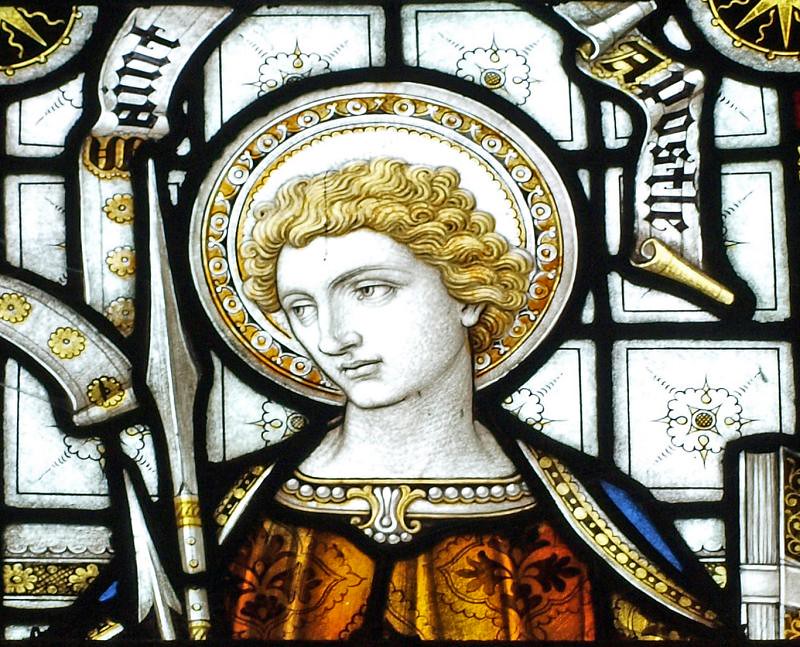
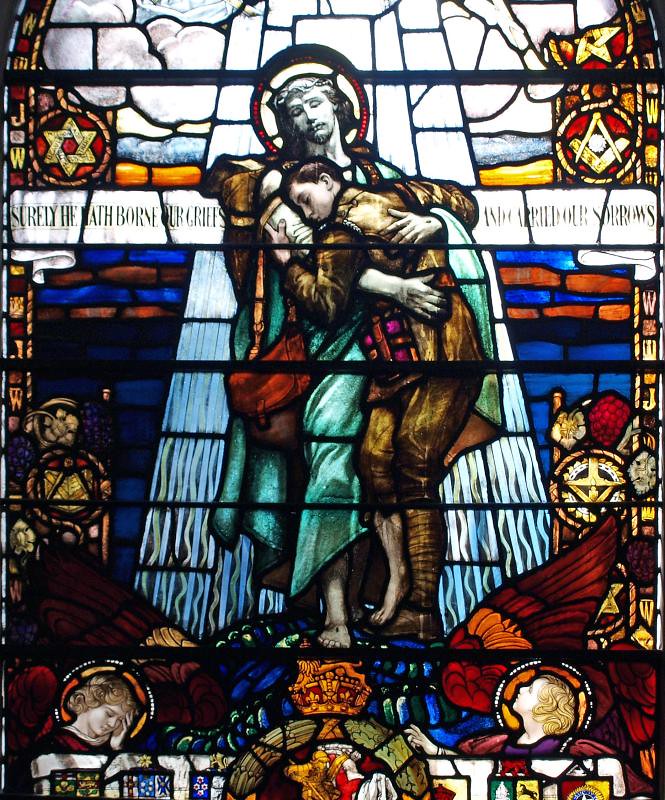
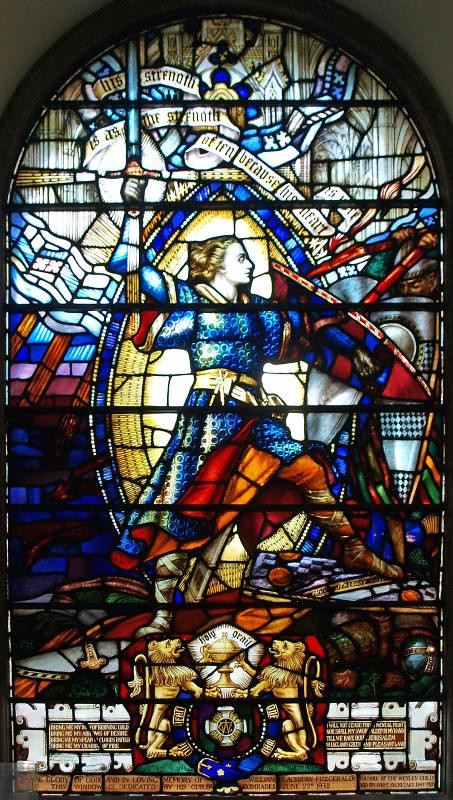
A window in the gallery shows Wesley preaching to the Red Indians in Georgia, and on the sunny side of the nave is another beautiful window by Frank Salisbury, in memory of the sending of the first Methodist missionaries to Australia. The window represents Spiritual Power, and shows an armoured knight with a flaming torch kneeling before a white-clad angel with outstretched arms. Near by is Mr Salisbury’s magnificent window to all Methodists who fell in the war, with a figure of Christ calling a soldier and bearing his pack on His own shoulders. Angels hold scrolls, and a wreath of oak and laurel encircles a figure of St George.

On the wall of the apse is John Wesley’s stone, starting with his dying words: “The best of all, God is with us,” and going on to say that “He went out into the highways and hedges calling sinners to repentance, and publishing the Gospel of Peace.” Carved on the stone is a shepherd’s crook, a winged trumpet, and light breaking from a cloud. A globe symbolises the worldwide spread of Methodism, and a Bible and prayer book suggest the foundations on which it is based. On the opposite wall is the stone of John’s brother Charles, headed by his famous words, “God buries His workmen, but carries on His work.” Carved volumes of hymns and poems illustrate the inscription, which says that “as a Christian poet he stood unrivalled, and his hymns will convey instruction and consolation as long as the English language shall be understood.”

Below, on a stone to Dr Coke, an early Methodist missionary, is a Negro pointing to his favourite text, a native of Ceylon reading a Testament in his own language, and a medallion relief of the sun setting in the sea, Coke having died on a voyage to the East.

The Methodist Crusaders

On the right of the apse are marble busts of two men who worked for the church in very different spheres, James Calvert, a confident  looking apostle of Fiji, and Sir Francis Lycett with a flower in his buttonhole, a man who did much for this chapel in the Victorian Era. On the south wall is a relief by Samuel Manning showing a woman reclining under a palm tree, a tall-masted ship in the background alluding to the business interests of Lancelot Haslope, who served the Methodists as treasurer a century ago. On the same wall is a stone to three generations of Macdonalds covering 144 years, from 1784 to 1928. On the other side of the chapel is a bust of Dr Jabez Bunting, who was buried here in the middle of last century, having finally severed Methodism from the Church of England.

Another famous preacher has a stone over the vestry door, and was buried in Wesley’s grave in the last year of the 18th century. He started life in Cornwall as a farmer’s boy and a carpenter’s apprentice, becoming celebrated when his floods of tears in the pulpit earned him the title of the Weeping Prophet.

Dr Morley Punshon’s white marble bust is on the north wall, a tribute to the five years he spent at the head of the Methodist churches in Canada. On the same wall is a bust of Dr Robert Newton, one of the most popular Methodist preachers, who travelled 7000 miles a year, making a profound impression wherever he went. His bust is by Dr Frederick James Jobson, a fervent preacher and architect, whose own bust is in a draped niche.

Facing the sunny side of the chapel is a marble bust of Dr William Fiddian Moulton, rare for showing him with spectacles. At 35 he became the youngest of the men who produced the Revised Version of the New Testament. He was the first headmaster of Leys School, Cambridge, and died there in the last years of last century.

In the graveyard are buried 5000 early Methodists, and at the back of the chapel lies Wesley himself, beneath a lofty pillar topped with an urn, “gloriously triumphing over death” at 87. “I should like to be buried here,” he said, “and on the morning of the resurrection rise with all my children round me.”

Surely He has borne our griefs (4)

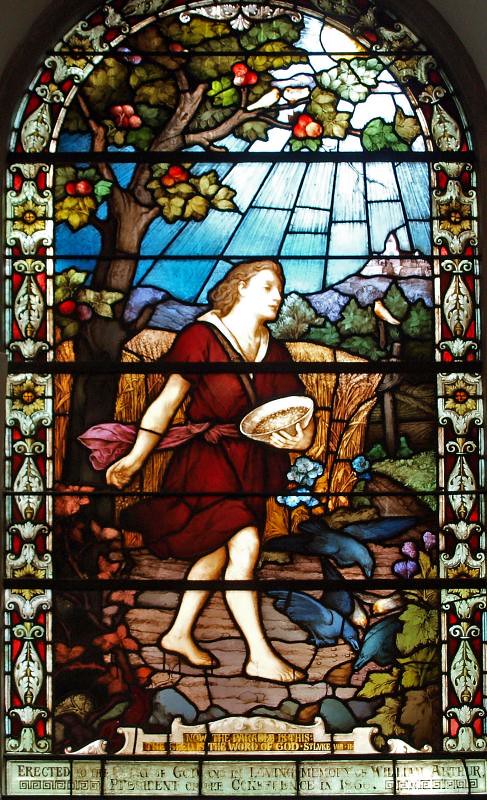
The seed is the word of God (3)

Frank O Salisbury (3)

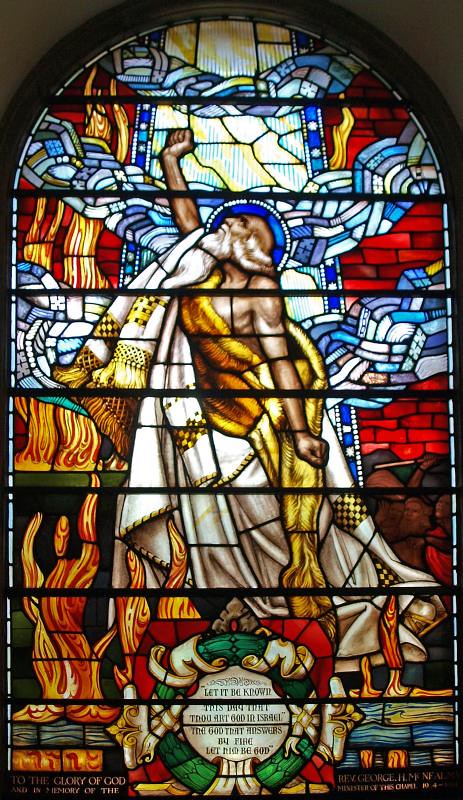
The God that answers by fire (1)

London, City - Bunhill Fields

I went to Bunhill Fields in the naive hope of finding some ancestor headstones forgetting that London graves tend to be illegible due to acid rain over the years. Even if the headstones were legible they are inaccessible to the casual visitor being railed off and accessible only on a £7 guided tour (The City Guides conduct guided walks around Bunhill Fields Burial Ground beginning at 12:30pm every Wednesday from April to October.).

Having said that it's very atmospheric and I did get to see Daniel Defoe, John Bunyan and William Blake's memorials.

HERE men were living in pile dwellings when Christ was born in Bethlehem, and stone tools have been picked up that were dropped long before then in what is now Clerkenwell Road. Here in the Middle Ages the youth of London came to skate and slide, and the wildfowler to shoot. It was not till the days of Plague and Fire that refugees from those twin calamities set up the first regular buildings in the marshes here. It became the home of the doctors long before Harley Street, and centuries have passed since watchmakers and jewellers and opticians made Clerkenwell their home. It has been the home of ancient and modern Crusaders, the Knights of St John of Jerusalem, and the Evangelists inspired by John Wesley. Today in working hours there are in Finsbury an average of 450 busy people for every one of its acres, though it is the smallest but one of all London boroughs, with only 587 acres.

It has within its borders a spot for ever sacred in the history of our race, a shabby place that should be made more beautiful. It is the little graveyard of Bunhill Fields. There is not an acre of English earth more precious than this, where we may look across the graves of four of England’s matchless men, John Bunyan, Isaac Watts, Daniel Defoe, and William Blake. One gave us the first great English story that will never die. One gave us the hymn sung by our race in all its triumphs and tribulations. One gave us a book beloved by every English speaking boy. One gave us our national anthem Jerusalem. In Bunhill Fields they lie almost together.

Blake’s grave is unmarked, but Bunyan’s has a sleeping stone figure of the immortal tinker and reliefs showing Christian with his burden and carrying the cross. The granite obelisk over Defoe’s grave was set up last century by 1700 youthful admirers of Robinson Crusoe, and near it is an obelisk to Isaac Watts, who was carried here from Lady Abney’s house at Stoke Newington, where he lived for 36 years. In a green space close by in Roseve Street lies George Fox, the heroic founder of the Quakers, and across the street lies John Wesley. Bunyan and Blake, Watts and Defoe, Wesley and Fox - we may wonder if anywhere else lie six such men in such a little space.

It is said that over a hundred thousand Nonconformists lie here, mingled with thousands of bones moved in Elizabethan days from Old St Paul’s. Here they brought criminals and victims of the Plague, mingling good and evil, proud and lowly. John Wesley laid his mother here, and here they laid General Fleetwood, who fought with Cromwell at Dunbar and married the Protector’s daughter. Near him lies the favourite minister of Cromwell, Thomas Goodwin, whose services the king refused with thanks before going to the scaffold, and who in a few years more stood by a bed in that same place while Cromwell passed away.

John Wesley lies across the City Road in the little graveyard behind his chapel, the mother of 108,000 churches. His bronze statue is under the trees, and shows him as a kindly-looking man in flowing robes, one hand raised in exhortation and in the other his little field Bible. On the pedestal are his famous words, The world is my parish. It was Wesley himself who laid the foundation stone of the chapel he made so famous. Here his body lay in state while thousands thronged past the coffin, looking on his face. Much of the building is as he knew it, though by the gabled front is a porch set on its columns about the time of Waterloo. In the lobby is a bronze relief of an angel mourning for 26,000 Wesleyans who fell in the war. Along the front wall stand six pine masts from English battleships, presented to Wesley by George the Third for supporting the gallery. Between them is a fine window by Frank Salisbury, a glow of inspiring colour, with a fiery figure of Sir Galahad brandishing a sword over the shadowy forms of Envy, Jealousy, and Greed, while below are the thrilling words of Blake’s Jerusalem.


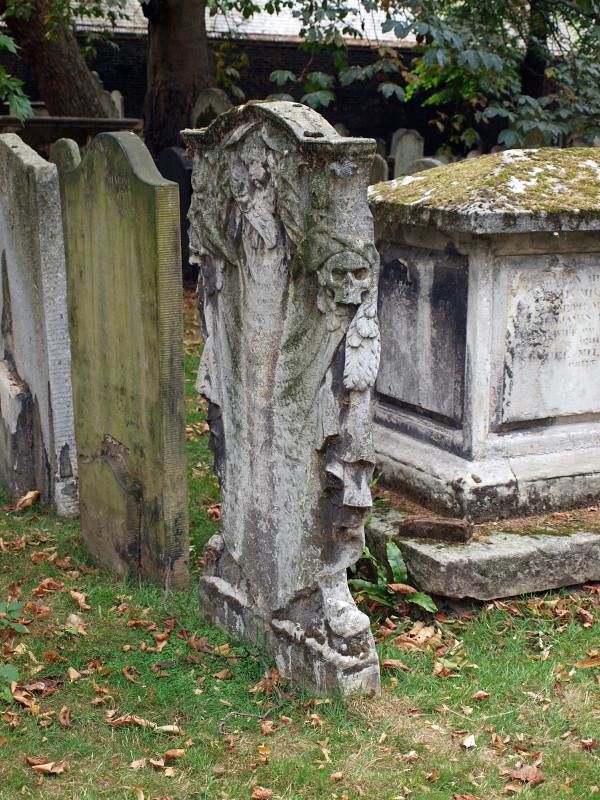
Headstone

Wednesday, 3 June 2015

Fitzroy Clinton Robarts

Fitzroy, my 2nd Great Granduncle, and his descendants, is another slippery bugger about whom I can find very little (and his wife and children even less).

He was born in Roehampton, Surrey on 11 May 1841 the third son of Abraham George Robarts (1810-1860) and Elizabeth Sarah nee Smyth (1816-1864).

In 1841 he's found with his parents at Besborough Cottage, Roehampton, Surrey, in 1851 he's a pupil at Berkswell Hall, Berkswell, Warwickshire and in 1861 he's enumerated as a banker - presumably with the family bank - with his mother at Russell Farm, Watford, Hertfordshire.

On 21st June 1862 he married Isabella Dorothea Sherlock and they had:
  • Catherine Elisabeth Fitzroy - 28 May 1864 - 1916
  • Fitzroy John 2 Mar 1866 - 2 Dec 1936
  • Fitzroy Clinton 1873 - 1905 (presumably named posthumously after his father)
In 1869 they moved to, and appear to have become naturalised citizens of, Belgium and he was living on his own means.

And that's about it except that he died on 17 June 1873 in Antwerp and that his daughter, Catherine, appears to have married - or at least had a son by - Victor Antoine Rochet (1857 - 1914) named Charles Rochet b. 1891

Isabella lived on until 1920 dying in Antwerp and outliving two of her children.