Sunday, 19 April 2015

Chaldon, Surrey

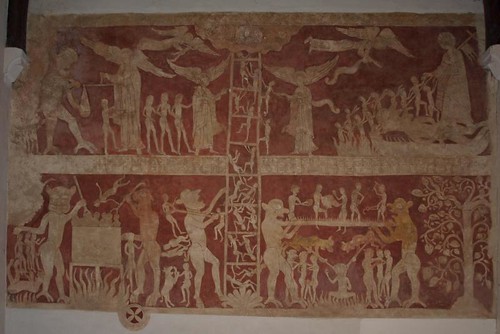
I've wanted to visit SS Peter & Paul for the extraordinarily early, and oddly placed (it's on the west end wall), C13th Doom wallpainting since my sister visited in May 2013 but timings and events have conspired against me until yesterday.

The painting is every bit as good as expected - perhaps even more so - but, despite a great location, I was disappointed with the building as a whole. Its diminutive exterior should be pleasing but isn't, to my eyes at least; it's all angular and jutting but that might be the Surrey vernacular to which I am unaccustomed.

Inside it's spartan, smaller than you'd expect and rather dull. Having said that it does have probably the most important mediaeval wallpainting in the country: which is nice.

I don't have the relevant Pevsner, Surrey's a long way from home, but more info on the Doom can be found here.

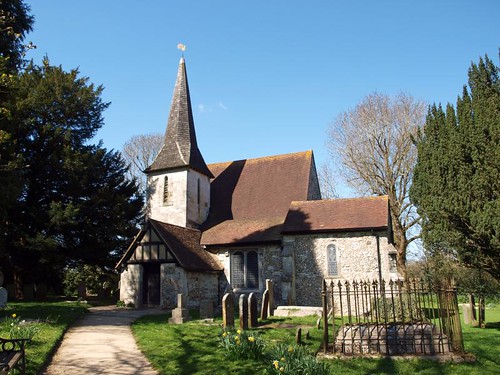
SS Peter & Paul (2)

Wallpainting (1)

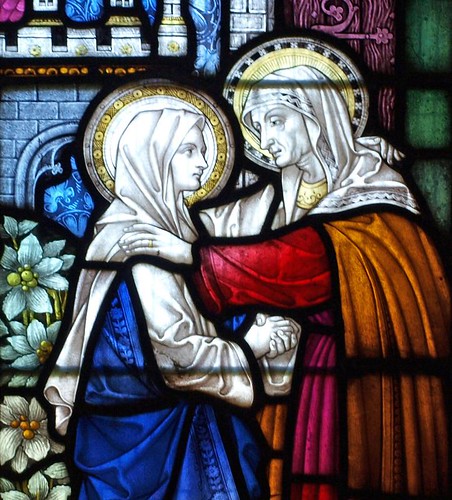
Mary & Elizabeth Clayton & Bell 1891 (2)

Chaldon. One famous thing draws the traveller to this beauty spot among the Surrey Downs, one of the finest ancient possessions of its kind in the land; but there are other treasures old and rare and quaint. They are gathered in the little church with more than 1000 years of history behind it, set quietly at home with Nature, its companion an ancient farmhouse with a bargeboard 600 years old.

The church is high and short and wide, with a tower and shingled spire rising up from a corner by the porch. The outlines of the nave and chancel are as they were in the century of the Conqueror, and some of the masonry from that time is still here. From the next century come one of the aisles and the chapel. The other aisle was built on two centuries later.

One of the curious possessions of Chaldon is in the chancel, next to an arched tomb 600 years old, a remarkable tablet with a face  in the form of a flaming sun. It does not seem to be anybody’s memorial, yet it has a message for all from 1562, and says:

Good Redar warne all men and women while they be here
to be ever good to the poore and nedy.
The cry of the poore is extreme and very sore.
In thys worlde we rune oure rase:
God graunte us to be with Christ in tyme and space.

It is possible that the initials on the tablet refer to John and Ellen Richardson, who were living here in Elizabeth’s reign and may have wished to preach this little sermon.

From a century later comes the fine pulpit, one of the few known to have been made in the Commonwealth. It bears the name of Patience Lambert, who had seen her husband buried in the nave below.

In the porch hangs the oldest bell in Surrey, and one of the oldest in the country, its voice still heard. It was certainly made before 1250 and may be several decades earlier, and it tells us that it is Paul’s bell. Its fellow, Peter’s Bell, was here 400 years ago, but is now lost; the two may well have been ringing in the Norman church.

The chief of all Chaldon’s treasures is counted among the rare possessions of England, adorning the oldest wall of the church with a little Norman window above it. It is the great painting of the Ladder of Salvation, leading up to heaven and down to hell, an extraordinary achievement of Norman art thought to be the work of a monk 750 years ago. Preserved by a coat of whitewash (under which it was found in 1870), it is in wonderful condition, something to fascinate old and young today as it has been fascinating the people of Chaldon for centuries.

This great picture, 17 feet long and 11 feet high, is filled with astonishing figures and scenes. As old as the Dream of Jacob, and perhaps much older, is the idea of the ladder of salvation with the ascending and descending figures. Halfway up the ladder is a band of cloud stretching the length of the picture. It is painted in the conventional manner of olden days and is the dividing line between the salvation of souls and the torments of hell. With the ladder it forms a great cross, cutting the picture into four parts.

At the right of the lower division is the Tree of Life. Its formal design is one of the clues that help us to guess the date of the picture, which was painted about 1170, the year St Thomas of Canterbury was murdered. A serpent is hiding among the branches. It is here that the story begins, for we are first reminded of the Fall of Man.

The remainder of the lower division shows the torments of hell. Next to the tree two huge demons hold up the bridge of spikes, over which cheating tradespeople, bearing symbols of their trades, are timidly walking. This punishment is another very old idea going back almost as far as thought can reach. The nightmare bridge over Gehenna was believed to be as narrow and sharp as a razor. A blacksmith is one of the unfortunate people in the act of crossing it. His hand is raised with a hammer, and he is ready to strike a red-hot horseshoe which he holds in pincers. Villagers of 700 years ago probably knew at once that he was the blacksmith of the well-known story who was condemned to forge a horseshoe without an anvil while crossing the bridge. The man who holds a bowl so carefully at the other end was probably a milkman who had given short measure to his customers, for the bowl is painted yellow and contains white fluid. He has been given the impossible task of carrying it across the bridge; and it looks as if he will soon be crying loudly over spilled milk in the awful abyss below, where a usurer sits among roaring flames on a fiery seat. A big purse of money hangs from his neck and three bags of gold are suspended from his waist.

Here again is a subject of countless stories familiar to the village people of mediaeval times. The usurer has no eyes, and gold coins, which he is forced to count, are pouring from his mouth. Two demons leap above him and prod at his head with their pitchforks. Fire is raging in the left division below the bar of clouds, where we see a great cauldron full of suffering souls. Two frightful demons are prodding them with pitchforks. The one on the left is holding a group of souls above a demon wolf gnawing at their feet, indicating that they are dancers, who were specially denounced by the monks of those days. A dog is about to bite a lady’s hand, the allusion being, no doubt, to the wealthy lady who pampered her dogs and fed them with the rich food she should have given in charity to the poor. Clinging frantically to the bottom of the Ladder of Life are more lost souls, most of them falling down, others being relentlessly picked off with a two-pronged fork by a monster demon showing his teeth. He is handing a victim over his shoulder to the demon of the cauldron.

It is a relief to look up to the top of the ladder, where angels help the good souls to reach the heaven of their aspirations. On the right, above the Tree of Life, is a dramatic rendering of the Descent into Hell. Satan lies bound, and Christ stands over him thrusting the staff of his banner into his mouth, while Adam and Eve and the souls of the patriarchs are set free.

The Weighing of Souls (on the left of the ladder) is one of the most interesting pictures in this old English Book of the Dead. Here is another idea found in ancient religions, particularly in that of the Egyptians. The Archangel Michael holds the scales. Another angel seems to be carrying a tablet with a record of good deeds. Satan, with his tongue out, is dragging along a group of souls by a rope, and slyly tries to press down the scales on his side and thus secure another victim. One fortunate soul is being lifted up to heaven by an angel.

In all England there is not a more complete example of 12th century painting than this. It is one of the most precious of our national possessions; only fragments are missing. In planning the picture the artist appears to have forestalled Dante, who used many of the same ideas in his Divine Comedy about 60 years after this Chaldon scene appeared. Here the artist has broken away from the Byzantine tradition of representing people conventionally. Although very few of the animated figures have faces they are full of expression and are painted in natural attitudes. The complicated subject is treated with great simplicity. The ease with which the painter has handled his brush, and the skill with which he has arranged the ideas he has taken from the legends and stories of his day, reveal him as an artist of no mean talent.

To the Chaldon people this painting must have been of tremendous interest. They could neither read nor write, but the picture’s story was something they could understand.

Thursday, 19 March 2015

London, Stepney - St Dunstan

The Church of St Dunstan by Walter Courtenay Pepys and Ernest Godman

THE Church of St. Dunstan stands in the churchyard on the east of Stepney High Street. It consists of a clear-storied nave of five bays, with wide aisles, western tower, and a choir of two bays, with a presbytery without aisles projecting eastward. There are also vestries adjoining the presbytery on the north, and north and south porches to the nave.

There is no chancel arch, but the choir is sufficiently defined by the meeting of the open high-pitched roof of the nave with the nearly flat chancel ceiling between the fifth and sixth bays from the west, and the presence of stairs formerly leading to the destroyed rood loft. The point is also marked on the north side by a heavier pier between the fifth and sixth arches.

The main alley of the church has a pitched roof covered with tiles, and is ceiled internally. The aisle roofs are flat and leaded.

Externally the church has been "restored" with such completeness that scarcely a vestige of old wrought stone work remains visible. The fabric is of various dates, but though the rubble walls in large part are probably much earlier, the bulk of the detail is coarse "Perpendicular"of various dates ranging through the fifteenth century. Of this period, naturally the most prolific in works of architecture, there are many features of similarity to those at St. Dunstan's in the neighbouring churches of Bow, West Ham, Barking, the old Tower of Hackney Church, and many others.

The interior has recently been entirely denuded of plaster, and despite several interesting disclosures made in the process, this is in many respects regrettable.

A chronological detailed description of the church being well-nigh impossible owing to the confusing effect of restorative zeal, perhaps the best course is to treat each feature in sequence from west to east.

The Western tower is 92 feet high, and in its lowest stage opens to the nave by a "Perpendicular" arch. Above is the ringing loft, and again the clock chamber, reached by a stone newel stair in the north-west corner, which continues to the tower roof. The stair turret is wholly internal. The large belfry contains ten bells. The tower roof, within modern battlements, has a curious louvred arrangement, which seems to incorporate the base of a former lantern now destroyed. In the "extra illustrated" copy of Lysons' Environs of London in the 12 other, apparently earlier, is undated. There is also an original drawing dated 1794. All these illustrations are in remarkable agreement, unusual in such cases, and each shows the tower roof surmounted by an octagonal cupola of pleasing design, 'ogee' in shape, apparently lead covered, and rising above an open arcaded stage standing upon a louvred base (the latter quite possibly that still existent and now hidden from view by the raised parapet). Surmounting the cupola is shown a gilded ball and vane terminating with a crown as finial.

In the 1795 view the roof over the nave is shown to be covered with lead, the chancel has an additional roof, as at present, which is covered with tiles. But it is evident that the chancel roof was also leaded in the first case, and that it was of the usual 15th century character, the lead covering being laid on the rafters and boarding which now appear only as an inner ceiling over the chancel; for we read that at a meeting of the Vestry, held on April 1, 1656:€”

      " the Churchwardens and others Jindeing a dropping downe of raine in severall places over the ChanceII by which the people were disturbed and that there was feare of the decayeing and rotting the timbers in that roofe to ye greate danger & damage of the people they did by themselves & workemen take a vewe upon the leads over the Chancell, which they found very defective, The charge of which (in case the lead bee taken upp and new cast) is estimated by the said workemen att £/\. $ y otherwise to bee only layde with a new crowne peece & the two gutters new layde with sodering and workemenshipp as itt now lyes will cost ^T"i 8, And the timber worke not valued, The consideration of this is left to the vestry. "

The matter was further considered at a meeting held on April 28th following, & the necessary works ordered, for which payment was authorized at a meeting in the following January. The exact nature of these works is not specified, but it may be that instead of the extensive repairs being made to the old lead flat, the additional roof, more steeply pitched and covered with tiles, was constructed. The chancel roof of the Chapel at Stratford Bow, which was of the same style and date, was treated in a similar manner about 1755.

The nave aisles were, until the 1899 restoration, filled with galleries which have been removed; the present seating of the nave is largely made up of old oak panelling of various 18th century types.

Both the aisle walls have been raised, probably when the present flat roofs were constructed. The character of the masonry changes about two feet below the present wall plates; below, it is random rubble, but the upper portion is partly brickwork and coursed. Externally at this level there are traces of a string course. The south aisle roof has fine carved braces, and the two eastern bays of this aisle were remodelled in the early 15th century period, evidently to form a chantry chapel, the walls being either rebuilt or increased in height and the windows enlarged.

In the north aisle of the nave the windows are of three lights with depressed four-centred untraceried heads, splayed jambs, and segmental rear-arches. Those in the south aisle are three light segmental pointed, also without tracery, in square jambs with through-arches and hollow chamfer. The window in the west wall of this aisle has formerly been similar, but is now reduced.

The clerestory has small, square-headed, two-light windows beneath segmental arches, & maybe of "Decorated" date; Perpendicular clerestories are generally larger. The nave is ceiled in oak with a flat four- centred barrel vault. Most of this is new, having been destroyed in the fire of 1901, together with the choir roof and organ.

The vaulted north and south porches are modern. The doorways, however, are good examples of fifteenth century date, and must always have been protected by porches of some description, being well preserved. Beside each is a stoup. A highly interesting Norman rood, now fixed on the north wall of the chancel, formerly surmounted the south door. In the engravings of the Guildhall 'Lysons' before-mentioned there are shown north and south porches to the nave, though these can scarcely be the original porches, as they are seemingly constructed of slight wooden framing with hipped roofs. The Norman rood shows clearly above the roof of the south porch. The drawing before referred to, entitled "Stepney before the alterations 1794”, also shows the western porch. The northern and southern porches originally had glazed sides, for in the Vestry minutes, June 18, 1619:€”

      "It is ordered that the Porches one upon the South side, the other upon the North side, be repaired;  the floores made even, and paved and the glasse windows amended. "

In a print in 'Maitland' 1755 the south porch is represented with glazed sides.

In 1610 a western porch beyond the tower was erected in the "Tuscan" style by Mr. Richard Phillips, churchwarden. It is represented in a print (no date) in ' Lysons ' published in 1811, and no doubt was demolished because it fitted so ill with the rest of the building. It never can have been required, the base of the tower forming every shelter requisite.

From wall to wall, passing in front of the fifth piers from the west, stood the ancient screen, the aisles continuing two bays beyond and forming chapels. In the south wall still remains the staircase giving access to the loft, and from thence to the roofs. This has been altered to serve the galleries, but the position and extent of the original openings are still visible. In the spandril between the two arches springing from the bulkier pier in the north arcade is a narrow arched opening from nave to aisle. A heavy beam with braces here provides a start for the lower ceiling of the choir and presbytery, and the two remaining bays of arcade are unclerestoried. The first arch eastward from this is depressed and of different outline to the remainder. Traces of a string course are noticeable some distance below the present roof, possibly marking the roof level of the 13th century church. In the north aisle the second window from the east is the only one remaining in the church with curvilinear tracery. It is a two-light window with splayed jambs and simple flowing tracery of the 14th century or "Decorated" period.

The two choir bays of the south aisle are now fitted as a chapel and divided from the main alley by a screen. The roof here is slightly higher and the three windows have moulded jambs and pointed arches almost equilateral in proportion, filled with Perpendicular tracery. At the east end of the north aisle is a door leading to the vestries and a squint to the high altar discovered during a recent restoration. On the eastern respond is now placed the Norman rood before mentioned.

The north wall of the presbytery is pierced by the squint and by a door to the vestries, which was disclosed during the 1899 restoration.

East of this and to the north of the high altar is the tomb to Sir Henry Collet 1510. Above is an arched window opening containing part of the organ.

The east window of five lights with lean Perpendicular tracery is very broad and low in proportion. Its jamb shafts with their caps are of 14th century date, & indicate the presence of an earlier window in this space. On the south wall are triple sedilia, "Early English" in style, but so exceedingly well preserved as to be objects of suspicion; an old print in the vestry shows these much mutilated. As a liberal coat of whitewash has recently been applied, it is impossible to see how much of the old work remains. The window above is of the date of the early 15th century alterations, but was restored during the last century. There is no piscina, its usual position being usurped by the tomb, with Greek Doric columns, to Benjamin Kenton. This was taken out by the Rector during the late restoration in the hope of discoveries, but as nothing was found it was replaced. West of the sedilia is a doorway now blocked and used as a cupboard.

Towards the top of the south wall of the presbytery and choir are traces of sharply-pointed arches at a higher level than the present. These would seem to be the rear-arches of earlier windows. Similar traces, not so well defined, exist in the north wall.

The vestries contain no work of architectural interest, but several good engravings and prints of the church in earlier times. Above is the organ loft. The organ destroyed in the recent fire had good Renaissance woodwork, some of which is preserved. In the gallery over the western entrance is also preserved a very fine oak poppy-head bench-end. The present ritual arrangement of the church does not coincide with the original. There is no screen, and the choir seating occupies one bay of the true choir and part of the presbytery, the nave having encroached one bay on the choir. An oak pulpit is placed on the north side, against the first pier from the east, and the font at the west end of the nave before the tower arch.

In 1806 the church was repaired both within side, and without, at the expense of at least £5000, on this occasion all the monuments were repaired, and the inscriptions restored with much care. (Harkian MS. Vol. I. 36). Unfortunately the vestry minutes of this date being lost, no details of this extensive restoration can be given.

In 1828 the Church was "thoroughly repaired and beautified" (Lewis' The 1828 & Topogr. Diet. )

In 1846-8 a restoration was recorded in an inscription upon the window over the east end of the nave which was destroyed in the great fire of October 1901 and not replaced.

This restoration was begun in the incumbency of the Rev. Daniel Vawdrey, and finished in that of the Rev. Richard Lee. It was not however until 1852 that the accounts were settled; the total cost was £3610. It was probably at this restoration that the east wall was refaced, unfortunately of brick instead of rubble, like the rest of the Church, and the galleries much reduced. A notice of this restoration occurs in the Rev. J. H. Sperling's Church Walks in Middlesex, 1849, together with architectural details of the fabric.
In the restoration of 1901 the east wall was refaced with rough stone to correspond with the remainder of the Church.

On the north wall at the west entrance is a brass, which records the restoration of the Church, and the erection of the porches and second Restoration vestry in 1871-2, during the incumbency of the Rev. J. Bardsley. It was at this restoration that the whole of the Church was refaced, a new organ built, and the west window filled with stained glass. At the restoration during the Rev. J. F. Kitto's incumbency (1885-6), in addition to cleaning and painting, the choir seats, a new pulpit and east window were added, the ground lowered all round the Church, and the main approach widened and deepened so as to bring it down to a level with the Church; before that two steps led down to the west door. The total expenditure was £3783.

The restoration of 1899, during the incumbency of the present rector, the Rev. A. E. Dalton, is commemorated on an inscribed brass tablet by Restoration the west door of the nave. The work included the removal of the galleries, stripping the plaster from the walls inside the Church, remodelling the seats, rebuilding the organ, re-hanging the bells, and placing the altar in the south chapel, at a total cost of £5,600.

The account of the great fire of October 1901 had better be given in the words of the Rector, as published by him in the Parish Report of Fire 1901-2:

      "October 12th, 1901, will be a day long remembered in Stepney. At 6.20 A. M the alarm was given that the Church was on fire, and it was soon found that owing to the morning being very foggy, and the fire being at the east end, right away from the road, it had obtained a strong hold ere it was discovered. How long it had been burning we shall never know. There was no smell of fire when the Church was closed at 9.30 the evening before. It originated from a gas jet in the stoke-hole under the vestry floor, that had been there for thirty years, within a foot of a wooden ceiling, which was protected only by a thin sheet of iron. Probably this had gradually worn thin, and the wood above it become more charred, till at last it ignited. Once through the vestry floor, the fire laid hold on the cupboards of cassocks and surplices, and within ten minutes of the alarm being given the flames were through the roof of the choir vestry. A wooden staircase carried them up to the organ chamber, which was a literal furnace before the first engine arrived, & thence the flames reached the roof, along which they raced with terrific speed. In a very few minutes 18 engines and 120 men of the Fire Brigade were on the spot, & though at first they feared the whole church was doomed, yet their energy and skill were equal to the task, and by cutting through the roof just before the fire reached the tower, they got it under control, and before 8 o'clock it was all out.

      Of the vestries only the bare walls remained, their contents being entirely destroyed, except the plate and registers, which were preserved intact by their safes.

      The organ was entirely gone, including the fine old front carved by Grinling Gibbons. Of the roof we have preserved only the main beam of the chancel arch, two out of the four big beams of the chancel, & the ten rafters next the tower. One bay of the north aisle roof was also destroyed. The altar was burnt owing to a portion of the organ falling upon it, and the choir stalls were considerably damaged by falling tiles, but otherwise the internal fittings were only damaged by smoke & water, thanks to the excellence of the old roof, none of which fell in. The east window was three-fourths destroyed, and two other of the stained glass windows considerably damaged. "

The subsequent repairs rendered necessary by this fire are also detailed in the following account by Mr. Dalton :

      "We have endeavoured to replace everything as it was before the fire, putting the roof back timber by timber in good English oak, only boarding it with oak instead of the deal of comparatively recent date. This and the new vestry doors have all been cut from the unburnt portions of the old oak timbers. The timbers of the roof, which were not touched in the restoration of 1899, were found to be very rotten, & before many years much repair must have been undertaken. Thus two corbels, each 12x15 inches, on which the centre beam of the nave roof rested, and which had been bedded 12 inches into the wall, were so completely rotten that not two inches of them remained. Now we have a roof sound and solid (the new chancel beams weighed two tons each) & one which we hope may last for another 400 years."

 A new altar was provided, and the choir seats restored in the places injured by fire.

The east and south windows in the chancel, and the east window of the north aisle, were replaced.

Notwithstanding the fact that St. Dunstan's Church appears to have suffered more, to judge by various records, than many of its neighbours in matters of spoliation or neglect of its monuments, there are still many preserved on the walls inside the Church: some are of considerable artistic merit, and not a few commemorate persons who became famous in the history of their times. In one, the monument to Dame Rebecca Berry, there is a wealth of local tradition owing to the fact that the arms on the sinister side of the shield bear, among other charges, a fish and ring (amulet); the monument has therefore been connected with the picturesque "fish and ring" legend, which appears, with slight variations, in many parts of the country. The interior Church was formerly much richer in memorials than now; two are given from Weever (Fun. Mon. ) on pp. 35-36; Norden (Speculum Brittania, 1593) mentions William Chaldnam and Joan his wife, 1484, "in the north aisle,  and Lady Anne Wentworth, 1571. Twenty-three monuments, which no longer exist, are also mentioned in Strype's edition of Stow (1720).

The following extract from Gough's Sepulchral Monuments, 1786, Vol. II. Part II. Page cccxxiv. Accounts for a great deal of this destruction both in Church and Churchyard:€”

      "How laudably attentive the Church Wardens of parish Churches among us are, will appear from the following Advertisement: 'Whereas there are many monuments, tombs and vaults in the Church and Chancel of St. Dunstan's Stepney, in a ruinous state, and many flat and headstones broken and sunk, or buried in the said Churchyard, and the said Churchyard from the great number of burials therein has become uneven, and in great need of a reform: The Church Wardens of the said Parish hereby give notice that all and every person or persons interested in any monument, vault, or flatstone in the said Church, or monument, tomb with flat or headstone in the said Churchyard, & who wish to preserve & perpetuate the same, that unless they apply to the Church Wardens, or any of them, on or before the first of January next, & agree to perform or pay for such repairs and replacing as are respectively necessary to such monuments, tombs, vaults, head and flatstones, that the same shall be removed without further notice, and that no grave in the said Churchyard will for the future be suffered to be raised above the surface of the ground. Thomas Taylor Ch. Warden Radcliffe. John Williams, Poplar & Blackwall. Matthias Kitchen, M. E. Old Town. William Cox,M. E. New Town.

The Vestry Minutes from 1777 to 1821 having been lost, the exact date of the above advertisement cannot be ascertained through the names of the Churchwardens, but probably it was about the time of the publication by Gough, viz. , 1786.

The inscriptions on the monuments, together with the heraldry, have been carefully copied, and are given below: the order in which they have been taken is beginning at the west end of the south aisle and proceeding eastward, returning from the chancel along the north aisle. It will be observed that the present position of some of the monuments does not agree with that given by the older authorities, because many of them were removed to their present places at the last restoration. Reference will also be found to the "beautifying" of the monuments during the restoration of the church, and it is to be feared that the original tinctures have in many cases been varied in the repainting of the shields. In an extra-illustrated copy of Lyson's Environs of London preserved in the Guildhall Library, many of these shields are described or illustrated, and when any reference to "Lysons" is made in the case of variations, it is this particular copy that is referred to.

NO. 1. EMMA RIMINGTON, 1852.

 A white marble tablet, with an inscription only, in memory of Emma Rimington, her husband Michael R. Junior, of Bombay, and her father Edward Thornhill of Upper Clapton.

NO. 2. DAME REBECCA BERRY, 1606.

This monument is in the form of a large shield, of stone, supported on a small bracket bearing a cherub's head. Above, it is surmounted by a coat of arms. Over all is an urn and a gilded lamp with the oil burning. The shield is in its heraldic colours, and the urn and shield are slightly gilt. Otherwise the stone (of unpolished marble) is left untouched, the black sunk lettering of the inscription filling the whole centre.

HERE LIETH INTERR D THE BODY OF DAME REBECCA BERRY, WIFE OF THOMAS ELTON OF STRATFORD BOW, GENT. WHO DEPARTED THIS LIFE, APRIL 26 1606 AGED 52

Come, Ladies, you that would appear like angels fair, come dress you here. Come dress you at this marble stone, And make that humble grace your own Which once adorn'd as fair a mind As e'er yet lodg'd in womankind. So she was dress'd whose humble life was free from pride, was free from strife, Free from all envious brauls and jarrs Of human life, the civil wars, These ne'er disturbed her peaceful mind. Which still was gentle, still was kind. Her very looks, her garb, her mein Disclosed the humble soul within. Trace her through every scene of life, View her as Widow, Virgin, Wife, Still the same humble she appears the same in youth, the same in years, The same in low and high estate Ne'er vext with this, ne'er mov'd with that So Ladies now, and if you'd be as fair, as great, as good as she Go learn of her humility.

Dame Berry's Monument.

This tablet was originally upon the exterior of the East Wall, and there appears in a print in "Lysons" date 1809. When it was removed to its present position is uncertain. It is known as "The Fish and the Ring" monument and has received perhaps more notice than it deserves, from the idea that the lady, whose virtues are recorded upon it, was the heroine of the common legend describing the loss of a ring, & its marvellous recovery from the inside of a fish. The legend appears in many places and many forms, and probably was only connected with Dame Berry from the Coat of Arms on the monument, which contains a fish and a ring.

Her first husband was the distinguished Admiral Sir J. Berry, whose monument is in the N. Aisle.

NO. 3. ALEX. WELLER, 1734.

The next, a white marble shield of similar size, around which carved drapery is shown. Below are crossed palm branches and above a coat of arms of which the bearings are almost obscured. According to Lysons they are as follows: Sa., 2 chevronels between 3 roses arg., impaling arg., a lion rampant gu., on a chief sa. 3 escallops arg. The inscription states that the body is interred "near the enterance of the western porch of this church."

Burial register.—Nov. 18, 1734. Alexander Weller of Old Artillery Ground.

NO. 4. JANE NEVILL, LADY DETHICK. 1606.

An elaborate wall-monument to Jane Nevill, Lady Dethick, occupies the central position on the south wall. It is of marble, the mouldings gilded, and consists of a central arch over the inscription, on each side of which two detached columns of black marble support a small projecting cornice, which overshadows the whole. Two gilded brackets are placed under the columns, & between them is a small panel with the name of the executor who erected the monument. The central inscription is in bold capitals and is given below. Above the caps of the columns, which are gilded and ornamented with egg-and-dart carving, is a gilt rose.
A coat of arms stands in a circle over the cornice, but (according to Lysons) they are not the arms of Lady Dethick, for she was a Duncomb of Buckinghamshire. She married as her second husband Alex. Nevill, Esq. The arms, according to Lysons, are: Quarterly of nine—
1. gu., on a saltire arg., a rose of the field. Nevill.
2. Fretty or and gu., on a canton erm. a ship sa. Nevill (ancient).
3. Gu. billety or, a lion rampant of the last. Bulmer.
4. Ermine (a crescent gu). (fn. 1) Eudo, Earl of Brittany.
5. Or, a chief indented az. Middleham.
6. Az. 3 crescents and semée of cross crosslets arg. Glanville.
7. Quarterly or and gu., a bend sa. Clavering.
8. Az. an escutcheon (barry of 4 arg. & gu.), (fn. 1) within an orle of martlets arg. Walcot.
9. Arg., on a chevron gu., 3 fleur-de-lys or. Pever.
Impaling Or, 5 eagles displayed in saltire, sa.

The inscription is as follows:

sacræ memoriæ ianæ nevillæ dominæ detheck matronæ religiosissimæ modestissimæ: omnibus qua corporis, qua animi (dum vixit) dotibvs orna tissimæ: jesu christi servæ devotissimæ: conivgi svæ fidelissimæ: amantissimæ qua cum viginti fere dvos annos felicissime transegerat; alexander nevillus armiger, hoc nunquam inter moritvri amoris sui monvmentvm fieri testamento curavit. postquam annos fere sexaginta novem vixerat, vicesimo nono novembris 1606 placidissime in domino obdormivit Tobiah worthington, alexandro nevillo ex testamento solus executor; ipsius mandato hoc monumentum posuit
Burial Register.—Dec. 1606. Jane Lady Detheck, als Garter, wife to the Worshipful Alexander Neville of Poplar, Esquire, buryed the first day of December.

NO. 5. REV. HENRY LECHE, 1742.

A plain white marble slab projecting slightly beyond two fluted pilasters which support it on each side, bears the inscription: "In memory of Henry Leche, clerk, late Rector of this Parish, who died June ye 15th, 1742." Below, two entwined branches are carved beneath a skull, & over the slab is the coat of arms and crest, coloured and gilt. Arms:—Erm., on a chief indented gu. three crowns or.
Burial Register.—June 18, 1742. Rev. Mr. Henry Leche, Rector of this Parish—buried in the Chancel.

NO. 7. CAPT. NATHANIEL OWEN, 1708.

A marble shield, draped, with two cherubs' heads at the top corners and a skull below, in memory of Capt. Nathaniel Owen, ob. Feb. 2, 1708, his first wife Mary, ob. Aug. 6, 1685, & second wife Bridget, ob. 16 March, 1709. Above is carved the coat of arms, uncoloured, but according to Lysons—Arg., a lion rampant sa. a canton of the second, impaling az., a fesse embattled erm. between 3 cockatrices' heads erased.

Burial Register.—1685. Aug 6. Mary wife of Capt Nathaniel Owen of Mileend mariner

NO. 8. NICHOLAS GIBSON, OB. 1510.

A Brass Tablet dated 1900, bearing a shield with the arms Az. 3 cranes, and inscribed To the memory of Nicholas Gibson, Sheriff of London, and Avis his wife, who founded A.D. 1538 The Coopers' Company's Grammar School at Ratcliffe, this brass was erected A.D. 1900 in grateful appreciation by the Association of Old Coopers' School Boys. They lie buried in the Chancel of this Church.
Now mercifull Iesu, which hast assysted owre intent
Have mercy on owre sowles, and as for the residew
If it be thy will, thou mayst owre act continew"

In Strype's Stow, 1720, is the following account of a monument to N. Gibson, which is stated to have stood on the S. side of the Chancel.

HEREUNDER LIETH BURIED NICHOLAS GIBSON, CITIZEN AND GROCER OF LONDON, AND AVIS HIS WIFE WHO WERE FOUNDERS OF THE FREE SCHOOLS AT RATCLIFFE, AND AFTER SHE MARRIED WITH SIR ANTHONY KNEVIT KNIGHT, WHICH LIETH HERE BURIED ALSO WHICH NICHOLAS DIED THE XXIIJ OF SEPTEMBER 1510. AND THE SAID LADY AVIS ALSO DIED THE THIRD DAY OF OCTOBER 1514 WHOSE SOULS JESU PARDON.

Weever has the following inscriptions upon this monument:

Here was I borne, and here I make myne end
Though I was Citizen and Grocer of London,
And to that office of Schrevalty did ascend;
But things transitorie passe and vanische sone,
To God be geeuen thanks if that I have ought done.
That to his honowre, and to the bringing vp of youth,
And to the succoure of the age; for sewerly this is soth.
By Avise my wyff children were left me non
Which we both did take as God had it sent;
And fixed our myndes that ioyntly in on,
To releeue the poore by mutual consent.
Now mercifull Iesu which hast assysted owre intent,
Have mercy on owre sowles, and as for the residew,
If it be thy will thou mayst owre act continew.

Upon the same marble these verses following:

The five and twentyth day of this monyth of Septembyr,
And of owre Lord God the fifteenth hundred and fowrty yeere,
Master Nicholas Gibson dyde as this tombe doth remembyr,
Whose wyff aftyr married the worschyful esquier,
Master William Kneuet, one of the Kings privy chamber,
Much for his time also did he endeuer
To make this act to continew for euer.

This pious act here mentioned in this epitaph, is a free school founded at Radcliff in this parish, by the said Nicholas and Avise for the instruction of threescore poor men's children, by a schoolmaster and an usher, with an almshouse, for fourteen poor aged persons; and this foundation continues to this day; (Weever). Both the almshouses and school were demolished about eight years since, and the inscribed tablets and stones from the buildings were obtained by the Survey Committee and presented to the London County Council, to be preserved in the Council's museum of London antiquities.

NO. 9. REV. GEO. HARPER, D. D. , 1815.

The next memorial is a stone sarcophagus represented with pilasters each side and natural foliage. Above, a pediment in which a gilt shield shows no arms visible. It is surrounded by a carved wreath of flowers.

NO. 10. DR. BLONDEL, 1734.

Beneath the last is a plain marble slab bearing the name of Jacobi Augusti Blondel, M. D. , and a long inscription. Two flat fluted pilasters stand each side, and over a small cornice is the coat of arms with a lamp each side, the flames of which are gilt. Arms : az. , 2 bars and in chief a mullet or.

NO. 11. LIEUTENANT HAROLD CHARRINGTON, R. N. , 1882.

To the Glory of God and in Memory of Lieutenant Harold Charrington, R. N. , second son of Spencer Charrington, Esq. , of this Parish, who was killed by Arabs in the Desert of Mount Sinai on August 11th 1882. This and the adjoining windows are dedicated by Friends of the Family.

 NO. 12. THOMASINE BREWSTER, 1596.

On the South wall is a dark marble slab into which are let two brasses, the one below bearing an inscription to the wife of John Brewster, Esq. 1596. The one above bears the coat of arms a chevron erm. between 3 estoiles, impaling a chevron erm. between 3 lion's heads erased, and a chief bearing no charges. The inscription is as follows:

HERE LYETH THE WIFE OF JOHN BREWSTER ESQ WHOS HEAVENLIE DEATH DECLARS HER HAPPY LYFE FAME SAYE THY WORSTE OF HER 1 THE DESIRE AND THOV MUST BLASE HER FOR A GODLY WYFE OF RICH & POORE THOV KNOWEST, BELOVED WAS SHE SPEAKE THOV THERFORE, THE REST OF HER FOR ME I SAYE NOE MOORE, HER NAME WAS THOMASINE TO WHOM NO DOUBPT THE LORD FORGAVE HER SINE NOW BLESSED IS ALMIGHTIE GOD THEREFORE AND PRAYSED BE HIS NAME FOR EVERMORE OBIIT ANNOS ETATIS SUE 46. ANNO DNI 1596

John Brewster was Secondary of the Fines Office, and appears in the Vestry Minutes as Auditor for Poplar 1589-91. He sat on the Vestries of 1589 and 1594, but then is entered as “gone”. He married first, Thomasine, d. of John Piers, and second Elizth. d. of R. Thornhill, and widow of Sir James Deane -his pedigree, and an account of the funeral of his second wife are to be seen (Brit. Mus. Add. MS. 14417. f. 5).

Burial Register—September 1596. Tomazin, wife of Mr John Brewster of Popler Esquier buryed the XIX day. a monument is set in the Chancell.

NO. 13. BENJAMIN KENTON, 1820.

Below is another brass to Benjamen Ken ton Esq. Ob. 25 May 1800. Above the name are the words "mortui resurgent " and a shield of circular form bearing the arms (the colours are hatched only): az. Y a fesse erm. , in chief fleur-de-lys, impaling chequee or and gu. T on a Jesse gu. 3 lions rampant.

 NO. 14. SIR THOS. SPERT, 1541.

A marble monument to Sir Thos. Spert in the South wall of the Chancel is of the same general design as that to Anne Nevill. Two black detached Corinthian columns with gilt capitals and bases support the cornice. The arch over the inscription (which is in gilt on black) is surrounded by a gilt moulding with egg-and-dart carving. A cherub's head, copper colour, with gilded hair forms the key & is flanked by two similar heads. Three or four large gilded roses and two smaller ones add to the ornamentation. Over the cornice are the arms gu., a saltire between 4 body hearts or, on a chief of the second a ship; (this according to Lysons, but the shield now shows an azure field) and on each side a marble obelisk. Between the brackets that support the columns is the date of erection of the monument by the Company of the Trinity House in 1723. A similar inscription further down commemorates its reparation in 1806, and between these two is a sunk panel with a carved representation of a three-masted boat. The inscription is as follows:

D. O. M.

Hereunder was laid up ye bodie of Sir Thomas Spert Kt, some tyme Comptrowller of the Navy to King Henry the 8th & both the first Founder and Master of the worthie Society or Corporation called the Trinity Hovse. He lived enobled by his owne Worth, and dyed ye 8th of September in ye yeare 1541, to whose pious Memorie the said Corporation hath gratefvlly erected this Memoriall.

Not that he needed Monument of Stone
For his well gotten Fame to rest upon:
But this was rear'd to testifie that he
Lives in their Loves that yet surviving be
For unto Virtue, who first raisd his Name
He left the preservation of the same
And to Posterity remaine it shall
When Brasse and Marble Monuments do fall.
Learn for to dye while thow hast breath
So shalt thow live after thy Death.

An: Dom. 1622, by the Company of the Trinitye Howse, this Monument was erected 81 years after ye Decease of theyr Founder. 1725. This monument was again repaired and Beautified by the Corporation of the Trinity House, in Commemoration of their Founder in the year 1806. Earl Spencer, Master. Capt. Ios. Cotton, Dep. Mastr.

Norden mentions this burial thus—

Also Sir Thomas Spert Knight, sometime Controller of the Shippes to H. 8. Dame Margary, Dame Anne and Dame Mary his wives lie in the Chauncell there - he deceased Anno 1541.

NO. 15. MARY LEYBOURNE, 1731.

A white stone tablet to Mary Leybourne with brownish-grey marble cornice and architrave, and pilasters each side, is placed high up in the South wall of the Chancel, at the extreme East end. Two lamps are carved above and stand be- side the coat of arms : az. 6 lions rampant, 3, 2, and 1 . Or. ; impaling gu. 3 lilies arg. A shaped sunk panel below is carved with a representation of a winged skull.

NO. 16 BENJAMIN KENTON.

Below the memorial to Mrs. Leybourne is a monument of white marble to Benjamin Kenton Esq. (1800). It consists of two fluted Doric columns supporting a curved frieze upon which are placed three shields, and between these, two ringed serpents. Behind the columns is a relief representing a scene from the parable of the good Samaritan. The base projects with a wider curve and has in its centre a panel with the inscription & some indifferent carving. The shields bear the following charges - 1. sa., a cross couped or, within a bordure of the last. 2. sa., a fesse erm., in chief 3 fleur-de-lys or, within a bordure of the last.

NO. 17. WILLIAM DAWTREY, 1589.

A little wall tablet of reddish marble to William Dawtrey contains an inscription in black letters in a square panel, on each side of which are two slight pilasters having two sunk panels of black marble in each. The whole is surmounted by a cornice on which is a shield, of which the charges are almost invisible. The lower portion has two small shields in relief and a black medallion in the centre. The arms, according to Lysons, are as follows:—Quarterly of 6, 1 & 6. Az., 5 fusils in fesse, arg.Dawtrey. 2. Az. 3 doves or.Wood. 3. Gu. a bend engrailed arg. between 6 crescents or.Rivers. 4. Sa., 3 garbs or, from each a dove rising arg.Skarfield. 5. Erm. 3 bars gu.Hussey. Impaling quarterly 1 & 4 Az. on a fesse between 3 stag's attires or, a fleur-de-lis of the field between 2 demi-roses gu.Stoneley. 2. A lion rampant bebruised with a baton. 3. A fesse vaire within a bordure engrailed, in chief an unicorn.
Wm. Dawtrey married Dorothy, daughter and co-heir of Rich. Stonely, of Warwickshire.

Inscription on Marble Tablet—

Genero suo. Gvlielmo Dawtrey Quondam Lincolniensis Hospitii socio: Wilhelmi Dawtrei sus sexiæ. Armigeri filio et Hæredi, Viro ingenii acumine Mentis acie, et non Vulgari Municipalium Angliæ legum Scientia, Præcellenti: Richardus Stonley Armiger Hoc amoris et Pietatis simbolum posvit. Obiit XVI Octobris 1589

NO. 18. REV. THOS. DOD, 1727.

A shield of excellent design surmounts a tablet of white and black veined marble, to the memory of the Rev. Thos. Dod, Rec tor of Stepney, his sons Thomas, d. 1726, John, d. 1730, his daughters Ellin, d. 1727, and Mary Colvill d. 1795, and his wife Mary, d. 1773. The inscription is on a white slab that occupies the whole centre. A winged skull is carved below. The arms upon the shield are thus described by Lysons : Arg. , on a fesse gu. Between 2 bars wavy sa. 3 crescents or, impaling gu. A lion rampant regard, or. The whole of the bearings do not, however, now appear, and the sable bars and red field are all that are coloured.

NO. 19. ROBERT CLARKE, 1610.

The monument to Robert Clarke and his daughter, is some height above the Chancel floor in the North Wall. A cornice of marble and two large pilasters enclose a recess in which are the figures of Robert Clarke and his wife kneeling facing one another on either side of an altar. The back is freely embellished with the usual strap ornament, fruit & flowers, all round a central panel which bears the inscription given below. The pilasters contain panels of black marble. Below is the English inscription which is divided into two parts by small pilasters, and beneath this the marble is of various colours. Two heads, floral ornament and a central boss complete the memorial. The arms are placed upon a corbel under the cornice and their description in Lysons runs thus they are his own parentheses: Barry of gu. & vert, 2 pellets (they should be plates), impaling sa. (it should be az. ) 2 pales engrailed between fleur-de-lis in chief or Langton.  The former is repeated above upon a shield surmounted by a cherub and on each side an urn. The monument is heavily gilt in parts, and the inner faces of the pilasters are ornamented with a gilt net- work of lines.

Inscription:—

IN OBITUM ROBERTE CLARKE GENEROSI QUI EX VITA HAC MIGRAVIT DIE MENSIS IN CLERICI TUMULO SPECTRUM VIDE FRAGILITATIS VANA VIRI EST VIRTUS VITA CADUCA CARO FLOS SICUT EST FUERIS SPIRANS FUIT HIC SICUT IPSE AST CELERI RAPUIT MORS VIOLENTA PEDE VTQ CADAT FLORES IN GERMINE MESSIS IN HERBA TURBINE COMOTUS SIC CLERICUS PERIIT VITA LICET BREVIS EST CŒLIS ÆTERNE MORATUR QUEM COLIT OMNIPOTENS TOLLITER HUIC CITIUS LAUDIBUS EXIGUIS DECORANS MAJORE MERENTEM DIMINUO LAUDES PIUS SIBI FAMA REFERT SI PIETAS CHARITAS BONITASQ IN MENTE REFULGENT HÆC UBI CORDE VIRENT OMNIA RECTA PUTES

Here resteth the bodie of Robert Clarke Esq. Sonne of Roger Clarke Esquire, late Alderman of the City of London, A man humble in prosperity, a liberall distributer to the poore, curteous & affable to all - an upright And a just dealer in this worlde and a devoute and most relligious seeker for the worlde to come. He had to wife Margaretta daughter to John Langton Esq. Sometyme Governor of the English Company in Sprucia under the Kinge of Polonia: whoe lived together in great love And integritie almost six yeeres He had by her one onely daughter named Frances Who lived one yeere and three quarters and here lyeth interred with her most deere and loving father. Whose memory the said Margaretta to express her true love and affeccon hath cavsed this Monument to be erected He dyed the xxxth day of May Ano Dni 1610 Having lived xxxv yeeres
Burial register.—June 12, 1610. Robert Clarke of Bednal greene, Gent. sonne to Alderman Clarke of London, deceased. he gave 36 mourninge gownes beside cloakes, and was buried the 12 of June.

NO. 20. SIR HENRY COLLET, 1510.

A large canopied altar tomb about seven feet wide, stands in a recess on the N. Side of the Chancel. The tomb itself projects from the recess ; it is of polished Purbeck marble, and has three square and four narrower panels of tracery on the face. The back and sides of the recess above are panelled, with two rows of arched and cusped heads, and the soffit of the canopy is carved to represent vaulting and pendants. The face of the canopy has arched and cusped heads, surmounted by a frieze of cusped quatrefoils. All the stone-work over the tomb itself is whitened. One of the shields in the tracery on the face of the tomb bears a small brass shield inscribed as under :

Here lyeth sir Henry Collet knight twice mayor of London who died in the year or our Redemption 1510.

The arms of Collet, as given by Lysons, are -  The Deanery of St. Paul's, impaling Sa., on a chevron engrailed between 3 hinds arg. as many annulets of the field -Colet. Weever adds a note to this inscription: This Henry was son to Robert Collet of Wendover in Bucks, and father to John Collet, Dean of St. Pauls, in the first time of his mayoralty the Crosse in Cheapside was new builded in that beautiful manner as it now standeth.

This monument is kept in repair by the Mercers' Company.

Sir H. Colet wills to be buried at Stepney, at the sepulchre before St. Dunstan and his monument is still to be seen on the N. side of the Church.Gough's Sepulchral Monuments 1786. Vol. I. Part I, p. 11.

The three following brasses, all of triangular shape, with inscriptions in Latin, are on the floor of the Chancel :

NO. 21. CHARLOTTE LEE, 1862.

Wife of the Rev. R. Lee, M. A. , Rector of Stepney 1847-1869.

NO. 22. EVAN JAMES, 1842 AND SARA ANNE JAMES, 1840.

NO. 23. BENJAMIN KENTON, 1800. See No. 16.

Weever (Fun. Mon. J also gives the two following monuments as being in the Church in his time :

JO. KITT, OR KITE, BISHOP OF CARLISLE, 1537.

Undyr this ston closyde and marmorate Lyeth JOHN KITTE Londoner natyffe. Encreasyng in vertues rose to high estate, In the fourth EDWARDS chappel by his yong lyffe, Sith whych the sevinth HENRYES servyce primatyffe Proceeding stil in vertuous efficase To be in favour with this our king's grase. With witt endewyd chosen to be legate Sent into Spayne, where he ryght ioyfully Combyned both prynces, in pease most amate: In Grece archbyshop elected worthely, And last of Carlyel rulying pastorally Kepyng nobyl houshold wyth grete hospitality: On thowsand fyve hundred thirty and sevyn, Invyterate wyth pastoral carys, consumyd with age, The nintenth of Iun reckonyd ful evyn, Passyd to hevyn from wordly pylgramage: Of whos soul good pepul of cherite Prey, as ye wold be preyd for ; for thus must ye lie. JESU mercy lady help.

RICHARD PACE, DEAN OF ST. PAUL'S, 1532.

Richardus iacet hie venerabilis ille decauus Qui fuit etatis doctus Apollo sue ; Eloquio, forma, ingenio, virtutibus, arte Nobilis, eternum viuere dignus erat. Consilio bonus, ingenio fuit vtilis acri, Facunda eloquij deteritate potens. Non rigidus, non ore minax, affabilis omni Tempore ; seu puero seu loquerere seni. Nulli vnquam nocuit, multos adiuvit, & omnes Officij studuit demeruisse bonos. Tantus hie et talis, ne non deleatur ademptus Flent muse, et laceris mesta minerua comis. Obijt anno 1532. Etat circiter40.

This PACE succeeded COLLET in the Deanery of Paul's, a man highly in favor with K. HENRY VIII. By whom he was employed as ambassador to MAXIMILIAN the German emperor; as also to Rome in the behalf of Cardinal WOLSEY, who stood in election for the pope dom. He wrote divers learned treatises yet extant. Nam vir erat (saith BALE) vtriusque literature peritia prasditus. Nemo ingenio candidior, aut humanitate amicitior: he was a right worthy man, and one who gave in counsel faithful advice; learned he was also, & indowed with many excellent gifts of nature, courteous, pleasant, and delighting in music, highly in the king's favor, & well heard in matters of weight. (Weever) .

MONUMENTS IN THE NORTH AISLE.

NO. 24. Stone panel, with sculpture of the Crucifixion, enclosed in an ornamented. From the character of the figures and the detail of the border, the date of the work is generally assigned to the 12th century probably the latter portion; and so, unless we accept the statement that the font still retains some of its original stonework, although restored, this panel is the oldest work now remaining in the Church. Until the 1899 restoration it was outside over the south door of the nave, but was then brought to its present position for better preservation.

NO. 25. Stone coffin lid, with moulded edges, bearing on its face a cross botonee, with a solid circle at the intersection of the arms, and surmounting a slender stem which stands on a base of 3 steps. The carving is in very low relief.

NO. 26. ANN MOOR, 1804.

A plain white marble slab, to Ann Moor, wife of Capt. John Moor, died at "Demarary, South America" 36

NO. 27. ANN ELDER, 181 1.

A plain white marble slab, on a simple base, recording also a bequest of five pounds a year to the Rector of Stepney for the time being, "to keep her family tomb (in the churchyard) in substantial and decent repair. "

NO. 28. A stone tablet, bearing no date, records that

"Ann Elder Gave by her Will the interest of £315 to three Daughters of Master Mariners under these conditions, that their respective fathers shall have been wrecked on the Coast of Cornwall, that they have attended the ser vices and sacraments of the Church of England, and be of deserving character. And that their respective ages be not under 20 years. Preference to be given to the Hamlet of Ratcliff, where they shall be resident at the time of their Fathers' misfortune. The above shall be given at the Vestry of the Church on the 4th Jany. In every year by the Rector. "

NO. 29. SIR JOHN BERRY, 1689.

A severely classical memorial to D. Joannes. Berry, who died in 1689: comprises a bust of himself in front of a black marble niche which is itself surmounted by architrave and pediment of white marble. The bust stands upon a curved pediment covering the inscription, which is in Latin, and forms a panel in a round frieze which with its architrave, completes the tablet. Lysons gives his arms: Or, 3 bars gu. , but they are not on the monument.
Inscription.

NE ID NESCIAS LECTOR, D JOANNES BERRY DEVONIENSIS, DIGNITATE, EQUESTRI. CLARUS, MARIS TANTUM NON IMPERATOR, DE REGE ET PATRIA, QUOD ET BARBARR NORUNT, BENE MERITCS. MAGNAM OB RES FORTITER GESTAS ADEPTUS GLORIAM FAM^ SATUR, POST MULT AS REPORT AT AS VICTORIAS, CUM AB ALUS VINCI NON POTUIT, FATIS CESSIT 1 4 FEBR 1 689 BAPTIZATUS 7 JAN 1 635

Burial register, Feb. 21, 1 689 Sr John Berry ofMileend, Knight.

NO. 30. HUGO JAMES, 1728.

A square tablet of white veined marble sunk in a deep moulding and surmounted by a shield, is that of Hugo James. His arms Arg. T a cross patonce gu.

NO. 31. NICHOLAS DIXON, 1818.

A plain white marble tablet, recording the above, and his wife Elizabeth Ann, d. 1823.

NO. 32. JOHN CHARRINGTON, 1815.

A white marble tablet, recording the above, who died Dec. 9th, and his wife Katherine, who died on the 1 3th of the same month. "They were interred the same day in the family vault at their native place, Aldenham, Herts."

NO. 33. LIEUTENANT HAROLD CHARRINGTON, R. N. , 1882.

A white marble tablet, in a frame of serpentine, to the memory of Lieut. Charrington, of H. M. S. Euryalus, and great-grandson of the above John ; who, together with Professor Edward Palmer, of Cambridge, and Capt. W. J. Gill, R. E. , was killed by Arabs in the Desert of Sinai. The inscription further records the interment of their remains in the crypt of St. Paul's Cathedral, and the erection, by the Admiral and officers of the 'Euryalus, ' of a tablet in Hunsdon Church, Herts., to the memory of Lieut. Charrington.

NO. 34. ELIZABETH STARTUTE, 1620.

Two recesses, one above the other, enclose figures of the deceased lady and the erectors of the monument. Dame Elizabeth Startute is above kneeling; two detached Corinthian columns support the frieze, upon which is an inscription, and under the soffit of the cornice are three gilded roses. The lower recess is the larger and holds the figures of Capt. Michael Merriall and Clare his wife, who was eldest daughter to Elizabeth Startute. They kneel opposite one another, an altar between.

The chief inscription lies in a space between the two recesses and below the two figures another inscription tells of the gift. Two roses finish the corbels to the columns and a winged skull is beneath the centre. The figures and ornaments are painted and gilded as is usual in the tombs of the same date. Over the top cornice stand the arms : Az. Y between 2 bend- lets gu. , 3 garbs sa. Lysons describes the field as argent.

Inscription:

TO THE MEMORY OF THEIR BELOVED MOTHER ELIZABTH THE WIDDOW OF RICHARD STARTUTE CITIZEN AND FISHMUNGER OF LONDON : WHO HAD ISSHUE BY HIM 3 SONS & 4 DAUGHTERS, AFTER I O YERES SPENT WTH HIMREMAYNED 34 YEARS HIS WIDDOW IN LIFE AND DEATH A CONSTANT EXAMPELE OF TRUE VIRTUE AND SWEETLY FEL-ASLEEP IN THE LORD DECEMBER 5, 1620. ETAT 74. CAPTAIN MICHAEL MERRIALL AND CLARE HIS WIFE, ELDEST DAUGHTER OF THE ABOVE NAMED ELIZABETH STARTUTE, HAVE ERECTED THIS MONU MENT AS A TESTIMONI OF HER VIRTV & THEIR LOV.. THIS LIFE IS A WARFARE. COME LORD IESUS COME QUICKLY. REV. 22

NO. 35. JOSEPH SOMES, 1845.

An elaborate monument, of Gothic design, in white and grey veined marbles, to J. Somes, M. P. for Dartmouth, and a prominent shipowner. The in scription is in a central arched recess, and over is a shield bearing the arms - Erm. A cinquefoil, on a canton an escallop. Below the inscription is a carving, in white marble, of "two full-rigged ships off the Port of London."

Burial Register.  July 2, 1 845. Joseph Somes of M. E. O. T. Age 58.

NO. 36. ABRAHAM RALLINGS, 1644.

A square rough stone with raised margin, to the above, and also to "Abraham his sonn " who died in the same year.

NO. 37. JOSEPH JEWSON COOPER, 1874.

A white scroll upon a black marble slab, with inscription, and the remains of a carving in relief at the top.
NO. 38. Over the doorway leading from the Chancel to the Vestry is a small mutilated sculpture representing the Annunciation, enclosed in a panel having a triangular cinquefoiled head. Previous to the recent restoration it was in the wall of the north porch, & before that, in Lysons' time, on the west wall of the Church.

The Font, which is generally regarded as the original one, though much restored, consists of a square bowl, the E. & W. Sides of which are ornamented with arcading. The south side contains a series of maltese crosses, each in the centre of an amulet, and the north side bears intersected triangles, filled with foliage at the extremities. It is supported by a central shaft, and at the four corners by pillars of Purbeck marble, with floriated capitals. At the base is a cruciform step which is raised upon a large circular slab of black marble. This slab bears upon it the following inscription: Presented by William Henry Hawkins, Esq. , 1848. Lysons refers to the font as "ancient, stands on a circular pillar, surrounded by four others of a smaller size "; it would appear, therefore, that if the present font is the original one, it has been re-chiselled and polished to such a degree in one or other of the frequent "restorations" of the Church as to effectually destroy all traces of its antiquity.

The brass eagle lectern is modern, and has upon its base inscriptions recording the restorations of the Church in 1871-3, and 1880-1, together with the names of the respective Rectors and Churchwardens during those periods.

Seating of in the nave and aisles is of plain oak, the sides and backs Church converted from the former high-backed pews. The choir stalls are also of oak.

There is a carving of the Royal Arms fixed on the nave wall above the tower arch; it bears no date. In form it is an oval shield surrounded by the motto of the Garter, and with the usual quarterings. Shield surmounted by a knight's helmet; supporters, crowned lion, and unicorn; motto, " Dieu et mon droit. " The whole surmounted by royal crown and lion.

THE CHURCHYARD AND ITS MONUMENTS.

CAPT. WILLIAM WILDEY, 1679. Altar tomb much decayed. Arms : a chevron gouttee bet. 3 martlets.

ABRAHAM ROBARTS, 1761, and family. Large altar tomb, enclosed by iron railings. Arms : 3 cross bows, a label for difference, on an escutcheon of pretence, a chevron gouttee bet. 3 birds close, for Wildey. Crest : a stag lodged regardant.

Flickr.
Thursday, 12 March 2015

Family tree

After just over a year the family tree is back online and now cross referenced with everyone born between 1771 and dying after 1841 against the 1841-1911 census returns. This amounted to about 8000 individuals and I'm now wondering what to do next - I'll probably go back to churching.

Anyway the new site can be found here.

Wednesday, 11 March 2015

Leicestershire & Rutland churches

I happened across a site today that covers Leicestershire & Rutland churches, not, I have to admit, in as much detail as I'd like but nonetheless it's shown me a wholly new and really exciting, to me, vernacular.

Almost all exteriors look stunning but the interiors appear to be a bit hit and miss; as usual due to insensitive Victorian restoration. Having said that there appears to be a lot of Norman work that has survived.

I think I might need to sell up and move northwards instead of doing the City of London churches next.

The best church, so far, has become a church I must see before I die: Titencote.

Monday, 23 February 2015

Sarah Starkins

Sarah, daughter of George and Elizabeth Starkins, married William Wallis (1743 - 1822), a liveryman and innkeeper living in Whitechapel and had issue: George Starkins Wallis 3 (1788 - 1864) and Sarah.

William's will was simple:

I, William Wallis, do hereby bequeath to my daughter, Sarah Ricket, the sum of one hundred pounds.

And the residue of my property I bequeath to my son, George Starkins Wallis.

And I do hereby appoint my said son, George Starkins Wallis, to be my sole executor and hereby declare all other wills made by me to be void, dated this twenty eighth day of November one thousand eight hundred and twenty two.

Proved at London 13th March 1823.

George Starkins Wallis 3, my children's 5x great grandfather, was born in Shoreditch in 1788 and married Elizabeth Appleton, by whom he had five sons and one daughter, in 1811 in Wanstead, Essex.

George 3 owned a livery stable in Whitechapel and, in 1848, was Master of the Worshipful Company of Upholders; in the 1861 census he was enumerated as a Magistrate living at 16 Mansell Street, Whitechapel.

His will is more extensive than his father's:

George Starkins Wallis of Mansell Street, Goodmans Fields in the County of Middlesex Esquire do hereby revoke all Wills and Codicils by me heretofore made and do declare this to be my last Will and Testament.

I direct that all my just debts and funeral and testamentary expenses be fully paid and satisfied as soon as conveniently may be after my decease by my Executers hereinafter named and appointed.

I bequeath to my daughter Emma the wife of Thomas Windle my Silver Teapot, Sugar Basin and Cream Jug and also my best set of China and also my Silver Forks and the Silver Inkstand presented to me by Sir William Clay, Baronet, and also my gold watch for her absolute use.

I bequeath to my Son in Law Thomas Windle my gold snuff box.

I bequeath to my son Walter White Wallis my Silver Tankard and also the several articles of Household Furniture in the bedroom he occupies in my dwelling house.

I bequeath to my Grandson William Wallis the son of my deceased son William the Silver Salver presented to me by the Guardians of Whitechapel Union.

I bequeath to my son Frederick John Wallis all the rest of my plate not hereinbefore bequeathed.

I bequeath to my daughter in law Emma Wallis the widow of my said son
William all the residue of my Household Goods and Furniture and also my books pictures prints wines glass and all the rest of my China not hereinbefore bequeathed for her own absolute use.

I give and bequeath to Mr.George Usley of Great Prescott Street and Mr. Richard Windle of Osborn Street, two of my Executers hereinafter named and appointed, the legacy or sum of Ten Pounds each for a gold ring to be purchased by each of them in remembrance of me.

I give devise and bequeath unto the said Thomas Windle, George Haley and Richard Windle all that my Freehold piece of ground with three houses erected on part thereof situate and being in Garden Street Stepney in the County of Middlesex and also all those my copyhold houses in Bloomsbury Terrace and John Street, Commercial Road in the County of Middlesex held by me of the Manor of Stebenheath otherwise Stepney to hold the same unto and to the use of the said Thomas Windle,  George Haley and Richard Windle and the survivors and survivor of them and the heirs of each survivor upon trust to pay and apply the rents and profits of the said last mentioned freehold and copyhold hereditaments and premises for the benefit of my four grandchildren  the sons and daughters of my late son William Wallis until the youngest of my said grandchildren shall attain the age of twenty one years and from and after such event happening upon  trust to sell the same hereditaments and premises and out of the purchase monies to arise from such sale to pay the expenses incurred in and about the same and shall divide the residue of such monies unto and equally amongst the said four children of my said son William Wallis  in equal shares and proportions with benefit of survivorship among them in case any or either of them shall depart this life under the age of twenty one  years.

And I give to the said Thomas Windle, George Haley and Richard Windle and the survivors and survivor of them and the executers and administrators  of such Survivor the sum of two thousand six hundred pounds sterling upon trust to invest the same in the Parliamentary Stock or Funds and to stand possessed of the same and the dividends and interest thereof upon the same trusts for the benefit of the said four children of my said son William Wallis as are hereinbefore directed with respect to the rents and profits of the said last mentioned freehold and copyhold hereditaments and the proceeds of the sale thereof.

I give and bequeath to my son Frederick John Wallis the legacy or sum of two hundred Pounds of lawful money.

I give and devise all my messuage or tenement situate and being No. 84 Whitechapel High Street in the County of Middlesex and also all that my freehold messuage or tenement in Angel Alley adjoining thereto with their appurtenances all which two messuages or tenements are on lease to Miss Wallis to the use of the said Thomas Windle,  George Haley and Richard Windle upon trust that the said Thomas Windle,  George Haley and Richard Windle their heirs and assigns shall pay the rents and profits of the said messuages or tenements and premises to my  daughter in law Jemima Wallis the wife of my said son Frederick John Wallis during the joint lives of my said daughter in law Jemima Wallis and her said husband for her separate use independent of her said husband and his debts control  and engagements and so that the said Jemima Wallis shall not have power to deprive herself of the benefit thereof by way of anticipation and for which her receipts alone shall be sufficient discharges and after the death of either of them the said Jemima Wallis and Frederick John Wallis shall sell the said last mentioned messuages or tenements and premises and after payment of the costs incurred in or about such sale shall invest the residue of the monies to arise from the sale thereof in their or his names or name in or upon such Stocks Funds and securities as are hereinbefore mentioned with power to vary the same at their or his discretion and shall hold the said trust monies Stocks Funds and securities in trust for all the children or any the child of my said son Frederick John Wallis who being sons shall attain the age of twenty one years or being daughters or daughter shall attain that age or marry and if more than one in equal shares.

I give and bequeath unto the said Thomas Windle, George Ilsley and Richard Windle and the survivor of them, his Executors and Administrators the sum of two thousand one hundred Pounds Sterling upon trust to invest the same in some or one of the Parliamentary Stocks or funds of Great Britain or in real securities in England or Wales in their or his names or name and to stand possessed of such Stocks,  Funds and securities and the Dividends, interest and annual produce thereof upon the like trusts for the separate use of my said daughter-in-law Jemima during the joint lives of herself and her husband and after the death of either of them upon the like trusts for the benefit of the children or child of the said Frederick John Wallis as are hereinbefore expressed and declared with respect to the rents and profits of the said last mentioned freehold and  copyhold premises and the proceeds of the sale thereof.

I give and bequeath unto each of the three children of my late son George Appleton Wallis deceased who shall have attained the age of twenty one years at the time of my decease the legacy or sum of five hundred and twenty five pounds and I give and bequeath to each of the three children of my said George Appleton Wallis who shall be under the age of twenty one years at the time of my decease the Legacy or sum of five hundred and twenty five pounds to be paid to them on their respectively attaining the age of twenty one years and I direct that the interest to accrue due on the legacies to the said last mentioned children during their respective minorities from the investment of the said several sums bequeathed to them as aforesaid shall be paid to their mother for their respective maintenance and education and in case any or either of the said last mentioned children shall die under the age of twenty years then I give and bequeath the legacy of him or her so dying unto the survivors or survivor of the said children of my said son George Appleton Wallis who shall live to attain the said age of twenty one years.

I give to each of my grandsons Alfred Wallis and George WALLIS the two sons of my deceased son Mark Wallis the legacy or sum of four hundred and fifty pounds to be paid to them on their respectively attaining the age of twenty one years and should either of them my said last named grandsons die under the said age of twenty one years then the legacy of him so dying shall go and be paid to the survivor of them and I direct that the interest or dividends to accrue due on the legacies to the said last named legatees during their respective minorities from the investment of the said several legacies bequeathed to them as aforesaid shall be paid to their mother for their respective maintenance.

I bequeath to my son Walter White Wallis the Legacy or sum of one thousand two hundred pounds sterling.

I also give and devise all that my estate at Roydon in the county of Essex being part freehold and part copyhold to the use of my said son Walter White Wallis and his heirs.

I also give and devise to my said son Walter White Wallis for his life an annuity or yearly rent charge of fifty pounds to be charged on and payable out of my copyhold estate consisting of a messuage or tenement stables, erections and buildings now In the occupation of Miss Croft and Mr Sanders situate in Whitechapel Road and Rummers Row in the parish of Saint Mary, Whitechapel and hamlet of Mile End Old Town in the County of Middlesex purchased  by me of the devisees of the late John  Clark Powell, deceased, to be paid by quarterly payments on the twenty fifth day of March, the twenty fourth day of June, the twenty ninth day of September and the twenty fifth day of December in each and every year without deduction the first payment to be made in such of the said quarterly days as shall happen next after my decease and a proportionate part to be paid up to the determination  thereof and I declare and direct that if the said annuity or yearly rent charge shall at any time be unpaid for twenty one days after any of the said days appointed for the payment thereof it shall be lawful for my said son Walter White Wallis to enter into and distrain upon the said copyhold premises hereinbefore charged therewith or any part thereof and to dispose according to law of the distress or distresses then and there found to the intent that thereby or otherwise the said annuity or yearly rent charge of fifty pounds and every part thereof so unpaid and all expenses incurred  by the non payment thereof shall be fully paid.

And I do hereby declare and direct that in case the said Walter White Wallis shall became bankrupt or shall, do. Permit or suffer to be done any act whereby the said annuity or yearly rent charge shall be seized or taken in execution or shall sell or dispose of, incumber or charge the said annuity or yearly rent charge or attempt to sell, dispose of or incumber the same then and in either of the said cases and from thenceforth the said annuity or yearly rent charge shall wholly cease, determine and be no longer payable or chargeable.

I give and devise all that my said Copyhold estate held by me of the Manor of Stebonheath otherwise Stepney consisting of the said messuage or tenement, stables, sheds, erections and buildings with the appurtenances now in the tenure or occupation of Miss Croft and Mr Sanders situate and being in Whitechapel Road and Rummers Row in the Parish of Saint Mary, Whitechapel and hamlet of Mile End Old Town in the county of Middlesex subject nevertheless and charged and chargeable with the payment of the said annuity of fifty pounds per Annum hereinbefore given and bequeathed by me to my said son Walter White Wallis as aforesaid and also all other my freehold and copyhold messuages or tenements, lands, hereditaments and premises hereinbefore specifically devised with the appurtenances to the use of the said  George Ilsley and Richard Windle their heirs and assigns upon trust that they the said George Ilsley and Richard Windle their heirs and assigns shall pay the rents and profits of the said several hereditaments and premises to my said daughter Emma Windle for her life for her separate use, independent of any husband and of his debts, control or engagements and so that the said Emma Windle shall not have power to deprive herself of the benefit thereof by way of anticipation and for which her receipts alone shall be sufficient discharges.

And I give and bequeath all the residue and remainder of my personal estate and effects whatsoever and wheresoever and of what nature or kindsoever not hereinbefore specifically bequeathed unto the said Thomas Windle, George Ilsley and Richard Windle, their executors and administrators upon trust that they or the survivor of them, his executors or administrators, shall as soon as convenient after my death sell, call in and convert into money such part of my said residuary personal estate as shall not consist of ready money and shall stand possessed of the monies to arise from such sale, calling in and conversion into money and of the ready money of which I shall die possessed upon trust, after payment thereout of my debts, funeral and testamentary expenses and the legacies hereinbefore bequeathed, to invest the residue or surplus of the said trust monies in their or his names or name in or upon any of such stocks, funds and securities as are hereinbefore mentioned with power to  vary the same at their or his discretion and shall pay the interest, dividends and annual produce thereof to my said daughter Emma Windle for her life for her separate use free from the debts, control or engagements of any husband but so that she may not have power to deprive herself of the benefit thereof in the way of anticipation and so that her receipts alone shall be sufficient discharge for the same and from and after the death of my said daughter Emma Windle I give, devise and bequeath my said copyhold estate and hereditaments in Whitechapel Road and Rummers Row aforesaid and also other my freehold and copyhold hereditaments and premises not hereinbefore  specifically devised and also all and singular the said last mentioned trust stock, funds and securities unto such person or persons and for such purposes as my said daughter Emma Windle shall, notwithstanding her coverture by dead or will or codicil appoint and in default of such appointment and so far as any such appointment shall not extend I give , devise and bequeath the said copyhold hereditaments in Whitechapel Road and Rummers Row aforesaid and also the said other freehold and copyhold hereditaments not specifically devised as aforesaid to the use of the right heirs of the said Emma Windle.

And I give and bequeath the said last mentioned trust stock funds and securities unto such person or persons as under the statues for the distribution of the estates of intestates would have became entitled thereto if the said Emma Windle had died possessed thereof intestate and unmarried such persons if more than one to take as tenants in common provided always.

And I declare that until my said messauges, lands and premises hereinbefore respectively devised as aforesaid shall be sold it shall be lawful for the said Thomas Windle, George Ilsley and Richard Windle or other the trustees or trustee of this my will for the time being at their or his discretion to demise all or any part of the same messuages, lands and premises with the appurtenances for any term of years absolute not exceeding twenty one years to take effect in possession so that there be required in every such demise the best yearly rent or rents to be incident to the immediate reversion that can be reasonably given without taking any fine, premium or  foregift or anything in the nature thereof provided always.

And I declare that in case any sale shall be made of my said freehold, copyhold and leasehold premises and residuary estate under the trusts hereinbefore declared it shall be lawful for the trustees or trustee for the time being of this my will to sell the same either together or in parcels and either by public auction or private contract with such stipulations as to title or evidence of title as the said trustees or trustee shall think fit with power to buy in the same premises or any part thereof at any sale by auction and to rescind after or vary any contract for Sale and to resell without being answerable for any loss to be occasioned thereby and to do and execute all such acts and assurances for effectuating any such sale as they or he shall think fit.

I devise all the freehold and copyhold estates vested in me upon trust or by way of mortgage to the said Thomas Windle, George Ilsley and Richard Windle, their heirs and assigns upon trust subject to the equities affecting the same respectively but the money occurred on such mortgage to be considered as part of my personal estate.

And I appoint the said Thomas Windle, George Ilsley and Richard Windle upon trust executors of this my will.

And I authorise the acting executors or executor for the time being of this my will to satisfy any debts claimed to be owing by me or my estate and any liabilities to which my estate may be obliged to be subject upon any evidence they or he shall think proper and to accept any compensation or security for any debt and to allow such time for payment (either with or without taking security) as to the said acting executors or executor shall seem fit and also to compromise or submit to arbitration and settle all accounts and matters belonging or relating to my estate and generally to act in regard thereto as they or he shall deem expedient without being responsible for any loss thereby  occasioned.

And I hereby declare that the receipts or receipt of the said Thomas Windle, George Ilsley and Richard Windle or the survivor of them or the heirs, executors or administrators of such survivor, their or his assigns or of the trustees or trustee for the time being acting in the execution of any of the trusts hereof for the purchase money of premises sold or for any rents, monies, funds or securities which may be paid or transferred to them or him in pursuance hereof of any of the trusts hereof shall effectually discharge the  purchaser or purchasers, lessee or lessees or other the person or persons paying or transferring the same therefrom and from being concerned to see to the application or being answerable for the misapplication thereof.

And I hereby declare that of the said Thomas Windle, George Ilsley and Richard Windle or any or either of them shall die in my lifetime or if they or any of them or any trustee or trustees to be appointed as hereinafter is mentioned shall after my death die or desire to be discharged or refuse or become incapable to act then and so often it shall be lawful for the surviving or continuing trustees or trustee for the time being (and for this purpose refusing or retiring trustees shall, if willing to act in this power, be considered as continuing trustees ) or for the acting executors or administrators of the last surviving or continuing trustee to appoint any other person or persons to be a trustee or trustees in the room of the trustee or trustees so dying or desiring to be discharged or refusing or becoming incapable to act and therefrom the said trust estates, monies and premises shall be vested in the new trustee or trustees jointly with the surviving or continuing trustee or trustees or solely as occasion  shall require and every new trustee shall (before and after the said trust premises shall have become so vested) have the same powers and discretion as if he had been hereby originally appointed a trustee.

And I exempt every trustee and executor of my will from liability from losses occurring without his or her own wilful default or by reason of any banker, broker or other person in whose hands any of the trust monies shall be placed or by reason of the insufficiency of any stocks, funds or securities.

And I authorise him or her to retain and allow to his co-trustee and co-executor all expenses incidental to the trusteeship or executorship.

In witness whereof I, the said testator George Starkins Wallis, have to this my last will and testament contained in nine sheets of paper set my hand to each sheet thereof this seventeenth day at February in the year of our Lord one thousand  eight hundred and sixty four…..

Proved at London 1st November 1864.

Late of Mansell Street, Goodmans Fields in the county of Middlesex Esquire and died 10th October 1864 at Mansell Street aforesaid.

Sunday, 22 February 2015

Thomas Wallis 1822

This is the last will and testament of me Thomas Wallis of Shepreth in the county of Cambridge, miller.

Whereas I gave unto my son, George Starkins Wallis, when we became co-partners in business a moiety of my stock in trade and whereas I also gave unto my two daughters, Ann Inkersole and Sarah Wedd, a fortune on their marriage now I do hereby give unto each of them my said daughters, Ann Inkersole and Sarah Wedd, a further sum of eight hundred pounds apiece to be paid to them by annual instalments of one hundred pounds a year each commencing from my decease until the whole be paid but without interest in the meantime.

Also I give to my brother Richard Wallis and his wife for their lives and the life of the survivor ten shillings a week.

Also I give unto my granddaughter, Sarah Wallis, daughter of my son, George Starkins Wallis, one thousand pounds to be paid her on her attaining her age of twenty one years or day of marriage which first happens with interest thereon in the meantime and which interest I direct to be applied as it becomes due for the purpose her education and subject and chargeable with the payment of my just debts and funeral and testamentary expenses.

I give and devise all my freehold and copyhold messuages, lands, tenements and heredits whatsoever unto my son, George Starkins Wallis, his heirs and assigns.

Also I give and bequeath unto the said George Starkins Wallis, his executors and admins, all the rest and residue of my stock in trade, crop and crops, book debts, securities, money, household furniture and all other my real and personal estate and effects whatsoever and wheresoever to and for his and their own present use and benefit subject to the payment of the said debts and expenses and of the aforesaid legacies.

And lastly I appoint my said son, George Starkins Wallis, sole executor of this my last will and testament hereby revoking etc...this second day of February in the year of our Lord 1822 etc...

This is a codicil to the above written last will and testament of me the above named Thomas Wallis.

First I revoke the legacies of eight hundred pounds each by my said will given to my two daughters, Ann Inkersole and Sarah Wedd, and interest thereof I give and bequeath to each of them, the said Ann Inkersole and Sarah Wedd, the legacy or sum of five hundred pounds apiece which two legacies of five hundred pounds each shall be payable by instalments of one pounds each; the first instalments to be paid out the end of one month after my decease, the next at the end of one year after my decease and the remaining instalments by yearly payments on the anniversary of my decease so as to discharge the whole of the said two legacies by the end of four years after my decease but without any interest in the meantime and I charge the said substituted legacies on my freehold and copyhold heredits.

And I revoke the annuity of ten shillings a week by my said will given to my brother, Richard Wallis, and his wife and in lieu thereof I give to my brother, Richard Wallis, an annuity of six shillings a week during his life commencing from my decease.

And I direct that in case my granddaughter, Sarah Wallis, should marry under the age of twenty one years without the consent of her father or his executors then her legacy of one thousand pounds given by my said will shall not be payable until she shall attain her age of twenty one years.

And in all other respects I ratify, confirm and establish my said will in witness whereof etc...on this eighth day of March in the year of our Lord one thousand eight hundred and twenty two.

Proved at London with a codicil 17 May 1822.

George Starkins 1843

This is the last will and testament of me George Starkins of Bishop Stortford in the county of Hertford esquire.

I devise my freehold messuage, homestead farm and lands called Whites Farm containing ninety eight acres or thereabouts be the same more or less situate in Magdalen Laver and North Weald in the county of Essex now in the occupation of __ James and also all my farm and lands adjoining to Oates Farm which was bought and purchased of {illegible}and now in the occupation of {illegible}and situate in High Laver in the said county of Essex to the uses following viz -

To the use of my nephew George Starkins Wallis of Meldreth in the county of Cambridge, Miller,  my friend Frederick Chaplin of Bishop Stortford afterwards Tanner and my friend Frederick Woodham Nash of The Temple, Barrister, and to their heirs and assigns during the life of my niece Sarah the wife of Charles Wedd now of Brentwood in the said county of Essex , farmer, without impeachment of waste in trust to pay the rents and profits of the said hereditaments to such persons and for such purposes only as the said Sarah Wedd by any writing under her hand shall from time to time as the said rents and profits shall become payable, but not by anticipation, direct or appoint and in default of such appointment unto her own hands for her separate use and so that the same shall not be subject to the control, debts or engagements of any husband and the receipts of my said niece or of her appointees shall alone be an effectual discharge for the said rents and profits and after her decease then as to my said {illegible}in High Laver to the use of my great niece Sarah the wife of Thomas Chaplin daughter of the said Sarah Wedd for her life and from and after her decease to all and every the children and child of my said great niece Sarah Chaplin in tail and if more than one to be divided between them in equal shares with {illegible}remainders among them in tail and if all such children but one shall be without issue or there shall be but one such child then the whole shall go to the use of that one child in tail and for default of such issue to such uses upon such trusts for such intents and purposes and subject to such limitations as the said Sarah Chaplin by her last will and testament in writing or any codicil or codicils thereto to be signed and published by her in the presence of and to be attested by three or more credible witnesses and made during coverture or when sole shall direct or appoint and in default of such direction or appointment and so far as any such appointment shall not extend to the use of the said Sarah Chaplin her heirs and assigns.

And as to the farm called Whites and the residue of the above devised premises - to the use of all and every the children and child of my said niece Sarah Wedd, except her two daughters the said Sarah Chaplin and Elizabeth Chaplin, in tail and if more than one to be divided between them in equal shares with {illegible}remainders between them in tail and if all such children (except the said Sarah Chaplin and Elizabeth Chaplin) but one shall be without issue or there shall be but one such child then the whole shall go to the use of that one child in tail and for default of such issue to {illegible}upon such trusts and for such interests and purposes and subject to such limitations as the said Sarah Wedd by her last will and testament in writing or any codicil or codicils thereto to be signed and published by her in the presence of and to be attested to by three or more credible witnesses shall direct or appoint and in default of such direction or appointment and so far as any such appointment shall not extend to the use of the said Sarah Wedd her heirs and assigns forever.

And whereas I am seized to me and my heirs or otherwise absolutely entitled to the manor of Oates and divers' freehold and copyhold messuages, farms, lands and other hereditaments situate at Oates, Matching, Magdalen Laver and at High Laver or some of them in the county of Essex not herein otherwise devised with their appurtenants and whereas I have {illegible}a map or plan of the said hereditaments to be prepared which I have divided by a line marked red into two portions or shared which I consider actual in value to each other the one which contains amongst other hereditaments the High Laver Farm and estates and which is described in this my will as the portion of my estates in which Laver Farm is situate and the other contains amongst other hereditaments a certain farm called Hogs Farm and I describe the place as the portion of my estate in which Hogs Farm is situate.

And I am desirous to adopt such division and delineation of property in the devises hereinafter contained of my above named hereditaments {illegible}in case the same map shall be lost or destroyed or the division made therein shall, in the judgement of the said Frederick Woodham Nash and Frederick Chaplin of Bishop Stortford, their executors or administrators, be obliterated or incapable of being rated or acted upon then I authorise the said Frederick Woodham Nash and Frederick Chaplin two of the executors of my will who are not interested in the said division, their executors or administrators, to cause the division to be declared or a new division to be made into two portions of equal value by two competent surveyors to be named by them and the said surveyors shall have power to appoint an umpire in case of their differing in opinion.

And I direct that the ascertainment of boundary award division or partition so made shall be binding on all the devises of the said hereditaments and premises.

Also I give and devise all that portion of my said estates in which High Laver Farm is situate to the uses following viz -

To the use of my nephew, George Starkins Wallis, and his assigns for his life without impeachment of waste and from and after his decease then as to one moiety of the said hereditaments devised to the said George Starkins Wallis to the use of the said Frederick Woodham Nash and the said Frederick Chaplin of Bishop Stortford their heirs and assigns during the life of my great niece Ann, the wife of Joseph Ellis, one of the daughters of the said George Starkins Wallis by his first wife without impeachment of waste in trust to pay the rents and profits of the said last mentioned hereditaments to such persons and for such purposes only as the said Ann Ellis by any writing under her hand shall from time to time, as the said rents and profits shall become payable but not by anticipation, direct or appoint and in default of such appointment into her own hands for her separate use and so that the same shall not be subject to the control, debts or engagements of any husband and the receipts of my great niece or of her appointees shall alone be an effectual discharge for the said rents and profits and after her decease to the use of all and every  the children and child of my said great niece, Ann Ellis, in tail and if more than one to be divided between them in equal shares with {illegible}remainders among them in tail and if all such children but one shall die without issue or there shall be but one such child then the whole shall go to the use of that one child in tail and for default of such issue to such uses for the benefit of my great niece Sarah the wife of Thomas Hacker Body (sister of the said Ann Ellis and also daughter of the said George Starkins Wallis by his first wife) and her children as are herein declared.

As to the other moiety of the said hereditaments devised to the said George Starkins Wallis or such of them as shall be then subsisting or capable of taking effect and from and after the determination thereof to the use of the person or persons who on the determination of all the previous limitations shall be the right heir or right heirs of the survivor of the said Ann Ellis and Sarah Body and the heirs of such person or persons for ever and such persons (if more than one) to take as tenants in common and as to the remaining moiety of the said hereditaments so devised to the said George Starkins Wallis from and after his decease to the use of the said Frederick Woodham Nash and Frederick Chaplin of Bishop Stortford aforesaid, their heirs and assigns during the life of my great niece, the said Sarah Body, without impeachment of waste in trust to pay the rents and profits of the said last mentioned hereditaments to such persons and for such purposes only as the said Sarah Body by any writing under her hand shall from time to time, as the said rents and profits shall become payable but not by anticipation, direct or appoint and in default of such appointment into her own hands for her separate use and so that the same shall not be subject to the control, debts and engagements of any husband and the receipts of the said Sarah Body or of her appointees shall alone be an effectual discharge for the said rents and profits and after her decease to the use of all and every the children and child of the said Sarah Body in tail and if more than one to be divided between them in equal shares with {illegible}remainders among them in tail and if all such children but one shall die without issue or there shall be but one such child then the whole shall go to the use of that one child in tail and for default of such issue to such uses for the benefit of the said Ann Ellis and her children as are herein contained as to the first mentioned moiety of the said hereditaments devised to the said George Starkins Wallis or such of them as shall be then subsisting or capable of taking effect and from and after the determination thereof to the use of the person or persons who on the determination of the previous limitations shall be the right heir or heirs of the survivor of the said Ann Ellis and Sarah Body and the heirs of such person or persons for ever and such persons (if more than one) to take as tenants in common.

And as to that potion of my said estates in which Hogs Farm is situate I charge the same with one clear annuity of one hundred pounds a year which I give and bequeath unto my great nephew James Inkersole, one of the sons of my late niece, Ann Inkersole, deceased, the late wife of John Inkersole, to be payable thereout to commence from my decease and to be payable quarterly at Lady day, Midsummer day, Michaelmas day and Christmas day in every year, the first quarter of the said annuity to be payable on such one of the days as shall occur next after my decease.

And I give to the said James Inkersole the same powers of distress for recovering the same when twenty one days in arrears after any quarterly day of payment as he would have had by law if the same were a cost reserved to him on a demise for years by him of the said premises and subject to the said annuity.

I give and devise the said last mentioned premises unto the said Frederick Woodham Nash, his executors, administrators and assigns for the term of one thousand years commencing from my decease upon the trusts hereinafter mentioned and subject to the said term.

I give and devise one moiety of the said last mentioned hereditaments and premises unto my great nephew Thomas Inkersole the eldest son of the said Ann Inkersole for and during the term of his natural life and from and after his decease to the use of all and every the children and child of the said Thomas Inkersole in tail and if more than one to be divided between them in equal shares with {illegible}remainders among them in tail and if all such children but one shall die without issue or there shall be but one such child then the whole shall go to the use of that one child in tail and for default of such issue to such uses upon such trusts for such intents and purposes and subject to such limitations as the said Thomas Inkersole by his last will and testament in writing or any codicil or codicils thereto to be signed and published by him in the presence of and to be attested by three or more credible witnesses shall direct or appoint and in default of such direction or appointment, and so far as any such appointment shall not extend to the use of my great nephew John Inkersole one other of the sons of the said Ann Inkersole and his heirs and assigns.

And subject to the said term I give and devise the remaining moiety of the said last mentioned premises and hereditaments unto my said great nephew John Inkersole for and during for and during the term of his natural life and from and after his decease to the use of all and every the children and child of the said John Inkersole in tail and if more than one to be divided between them in equal shares with {illegible}remainders among them in tail and if all such children but one shall die without issue or there shall be but one such child then the whole shall go to the use of that one child in tail and for default of such issue to such uses upon such trusts for such intents and purposes and subject to such limitations as the said John Inkersole by his last will and testament in writing or any codicil or codicils thereto to be signed and published by him in the presence of and to be attested by three or more credible witnesses shall direct or appoint and in default of such direction or appointment, and so far as any such appointment shall not extend to the use of my great nephew Thomas Inkersole and his heirs and assigns.

And I declare that the said term of one thousand years hereinbefore limited to the said Frederick Woodham Nash is so limited upon trust out of the rents and profits of the hereditaments comprised in the said term or by mortgage or sale of the same premises or any part thereof or by any other means to {illegible}for the portion of my great niece Mary Inkersole one of the daughters of the said Ann Inkersole, deceased, the sum of two thousand pounds which I give thereout to the said Mary Inkersole and for the portion of my great niece Elizabeth Inkersole another daughter of the said Ann Inkersole a like sum of two thousand pounds which I give thereout to the said Elizabeth Inkersole the portion of each such daughter to be raisable and payable when and as she shall attain the age of twenty one years or marry with interest after the rate of four pounds per cent per annum for the said portion or portions from the respective period or periods at which the same ought to be raised and paid until the same shall be actually raised and paid.

And I declare that when the trusts of the said term of one thousand years shall be satisfied or become unnecessary the said terms shall respectively cease.

And I enjoin the said before mentioned devisees, as {illegible} as I lawfully can or may do, not to sell or dispose of their shares in the said hereditaments and premises to any other person than to some or one or more of the devisees entitled either in possession or reversion to some other share in the said hereditaments and premises.

And I enjoin the devisee or devisees best {illegible} to sell his, her or their shares to offer the same to some one or more of the said devisees at a price to be fixed by two arbitrators, one named by the selling and one by the purchasing party of by the umpire to be named by such two persons.

And I declare every estate for life hereinbefore limited to be unimpeachable for waste and for the purpose of preserving the contingent remainders before in this my will created from being destroyed.

I give, devise and appoint the hereditaments by this my will limited to any person during the term of his or her natural life immediately after the determination of that estate by forfeiture or otherwise during his or her respective lifetime unto and to the use of the said Frederick Chaplin of Bishop Stortford and to his heirs during the life of the tenant for life whose estate shall so determine in trust for him or her and by the usual means to preserve the contingent remainders expecting or depending thereon from being destroyed provided always.

And I do hereby declare that it shall be lawful for every person who by virtue of this my will shall be tenant for life in possession or tenant in tail in possession of the hereditaments hereby devised and who shall have attained his or her age of twenty one years and to the said George Starkins Wallis, Frederick Woodham Nash and Frederick Chaplin and the survivors and survivor of them and the executors or administrators of such survivor from time to time during the minority of any such tenant for life or in tail by deed or instrument in writing to limit or appoint by way of lease all or any part of the said hereditaments to any person for any term not exceeding twenty one years to be computed from the making thereof at the best yearly rent that can be reasonably gotten for the same without taking any fine or foregift for the making thereof but so that there be contained therein a condition of re-entry for non-payment of the rent thereby to be reserved and so that the lessee execute a counterpart thereof and thereby covenant for the payment of the rent and be not by any clause or words therein to be contained made dispunishable for waste.

I declare that the trustees or trustee for the time being under this my will shall, during the minority or respective minorities of any child or children who shall be entitled to any estate in possession in any of the hereditaments hereby settled to any portions thereof, receive the income arising from such estate or any portion thereof and shall and may apply the whole or a competent part thereof for or towards the maintenance and education of the child or children so entitled to such estate or any portion thereof and the said trustees shall accumulate by investment in the government funds or other government or real securities any income which shall not be so applied as aforesaid and all or any part of the accumulation derived from the income of any such interest in the said hereditaments or any part thereof shall be applicable by the said trustee or trustees to the same purposes of maintenance and education or to the advancement, establishment or otherwise for the benefit of the child or children entitled to such interest and subject thereto the said accumulations shall be held by the said trustees and trustee upon trusts corresponding with the limitations of the estates from whence such accumulations shall have proceeded.

And I charge all my freehold and copyhold messuages, lands and hereditaments situate at Bishop Stortford aforesaid not hereinafter absolutely disposed of and all my freehold and copyhold hereditaments situate in the parish of Elsenham in the county of Essex and also my freehold farm containing about two hundred and four acres, more or less, in Wallasea Island in the parish of Canewdon in the said county of Essex with the payment of all my just debts, funeral and testamentary expenses and legacies in and of my said residuary personal estate and for that purpose I declare that my personal representatives or representative for the time being shall and may raise any sum or sums of money for the purpose aforesaid by sale or mortgage of the said farms and premises or any part thereof and in case of mortgage to limit a term or terms of years for securing the sum or sums of money so raised and interest for the same or to sell and absolutely dispose of and convey the said messuages, lands, hereditaments and premises for the purposes aforesaid and their or his receipts shall exonerate the person or persons advancing such sum or sums of money or paying any purchase money or monies from all obligation of seeing to the application thereof or {illegible} into the necessity or {illegible} the same mortgage money or selling or disposing of the said messuages, lands, hereditaments and premises.

And I direct my said executors to apply in the first place to the payment of the said debts, legacies and expenses, the purchase money to be received from the said Frederick Chaplin under the power of purchasing my hereditaments at Bishop Stortford aforesaid hereinafter given to him and in the next place to sell or mortgage the said hereditaments in Wallasea Island aforesaid and Bishop Stortford and if the same are not sufficient then to sell or mortgage the said hereditaments at Elsenham aforesaid but no purchaser or mortgagee shall be bound to enquire whether such order of sale or mortgage has been processed nor be affected by or answerable for any deviation from such order nor for any breach of these directions and subject to and from and after full payment of all the said debts, funeral and testamentary expenses and legacies.

I give and devise the said hereditaments and premises at Bishop Stortford aforesaid not hereinafter absolutely disposed of and all the said hereditaments in Wallasea Island and Elsenham aforesaid in manner following, that is to say:

One moiety thereof to my said nephew George Starkins Wallis and his heirs and the other moiety thereof to and between the children of my said late niece, Ann Inkersole, except her son, the said James Inkersole, and their heirs as tenants in common.

Also I give and devise all the capital messuage or tenement now in my own occupation situate at Bishop Stortford aforesaid and the stables and outbuildings therewith, wood and the yard and garden hothouses and buildings thereon and the gateways and entrances to the same premises from the street to the said Frederick Chaplin of Bishop Stortford and his heirs.

Also I give and bequeath unto the said Frederick Chaplin the furniture of and belonging to the dressing room and dining room of my said capital messuage for his own use.

And I empower the said Frederick Chaplin of Bishop Stortford after my decease, if shall think fit, to purchase all the cottages and appurtenances thereto in the front of my dwelling house next the street in Bishop Stortford aforementioned at such price as the same shall be valued by two persons, one to be chosen by the said Frederick Chaplin and the other by the said George Starkins Wallis his executors or administrators and in case such two persons shall differ in opinion then by an umpire to be chosen by such two persons.

And I empower the said Frederick Chaplin to purchase the land or piece of ground called the Half Acre and the field adjoining at the price or sum of one hundred pounds an acre and if he shall, within six months after my decease, elect to purchase either of the said premises at the sum above mentioned I empower my personal representative or representatives receiving the said sums respectively to convey and assure either of the said premises in respect whereof the above mentioned purchase money shall be so paid unto the said Frederick Chaplin and his heirs or to a trustee and his heirs to the use of or in trust for the said Frederick Chaplin and his heirs and if he shall refuse to make such purchase then I authorize and empower my personal representatives to sell the said hereditaments and premises to any other person or persons and his or their heirs.

And I direct that the receipt or receipts of the said George Starkins Wallis and Frederick Woodham Nash or the survivor of them, his executors or administrators for either of the said sums if payable by the said Frederick Chaplin and of my personal representatives or representative for the time being if payable by any other person or persons shall effectually discharge the said Frederick Chaplin and his heirs or any other purchaser or purchasers of the said hereditaments or any part thereof therefrom.

And I direct that the said purchase money so paid shall be applied in the first place for payment of my debts, funeral and testamentary expenses and legacies herein mentioned and subject thereto and as to so much thereof as shall not be required for the purposes aforesaid I direct that the same shall sink into and become part of and go with my residuary personal estate.

Also I give and bequeath to my great niece, Elizabeth Chaplin, one of the daughters of the said Sarah Wedd, the sum of five hundred pounds of lawful money to be payable at the end of three months from my decease in addition to the advancement which I gave and paid to her on her marriage.

Also I give and bequeath to the said Frederick Woodham Nash the sum of two hundred and fifty pounds for his trouble in acting as my executor, to my cousin, George Wallis of Whitechapel three hundred pounds, to my cousin Mary, the widow of James Marwhinnie, two hundred pounds.

I bequeath to my respected friend and minister, the Reverend William Chaplin of Bishop Stortford, the sum of two hundred and fifty pounds.

Also to my servant William Christy, if he shall be in my service at my decease, the sum of nineteen pounds nineteen shillings.

Also to my servant Hannah Hurley, if she shall be in my service at my decease, the sum of nineteen pounds nineteen shillings.

Also I give to my late servant, Sarah Hanson, the sum of nineteen pounds nineteen shillings.

I direct that all stocks, funds and securities which shall be subject to any of the trusts of this my will shall from time to time be altered, varied and transposed by the trustees or trustee thereof and as they shall think proper and that the receipt or receipts of the acting trustee or trustees for the time being under this my will shall be an effectual discharge for all monies subject to the trusts of this my will or any of them.

Also I give all debts and sums of money which shall, at the time of my decease, be due or owing to me from the said Charles Wedd to all and every the children of my said niece, Sarah Wedd, his wife in equal shares.

Also I give all debts and sums of money which shall, at the time of my decease, be due or owing to me from the said John Inkersole, late husband of my said niece, Ann Inkersole, deceased, to all and every the children of my late niece, the said Ann Inkersole, his late wife, in equal shares.

Also I devise and bequeath unto my said nephew, George Starkins Wallis, all debts and sums of money which shall, at the time of my decease, due or owing to me from him, the said George Starkins Wallis, and subject to the payment of my debts, funeral and testamentary expenses and legacies.

I bequeath all my personal estate and effects whatsoever and wheresoever except such as is herein otherwise bequested in manner following that is to say one moiety to my nephew, the said George Starkins Wallis, and the other moiety to and between all the children of my late niece, Ann Inkersole, (except her said son James Inkersole) in equal shares for their own absolute use.

I give, devise and bequeath unto the said George Starkins Wallis, Frederick Woodham Nash and Frederick Chaplin of Bishop Stortford, their heirs, executors, administrators and assigns respectively all the estates which, at the time of my decease, shall be vested in me upon any trusts or by way of mortgage of which I have power to dispose of by this my will with their rights, members and appurtenances to have and to hold the same premises unto the said George Starkins Wallis, Frederick Woodham Nash and Frederick Chaplin of Bishop Stortford, their heirs, executors, administrators and assigns respectively according to the nature and quality thereof respectively upon the trusts and subject to the equity of redemption which at the time of my decease shall be subsisting or capable of taking effect therein respectively and the money serviced on such mortgages shall be considered and taken as part of my personal estate.

And I do hereby nominate and appoint the said George Starkins Wallis, Frederick Chaplin of Bishop Stortford and Frederick Woodham Nash to be executors of this my last will and testament.

And I hereby authorise and empower my executors to pay any debts owing by me or claimed from me upon any evidence they shall think proper and to accept compositions or a part for the whole from any debtor and to accept any security, real or personal, for any debt or debts owing to me and also to allow such time for the payment thereof as to them or him shall appear reasonable provided always.

And I do hereby declare my will and mind to be that if the said respective trustees hereby appointed or the trustees to be appointed as hereinafter is mentioned or their respective heirs, executors or administrators or any of them shall depart this life, desire to be discharged from or decline or become incapable to act in the trusts hereby reposed in them then and so often as it shall so happen it shall be lawful for the surviving or continuing trustees or trustee for the time being of the trust estates, monies and premises the trustees or trustee whereof shall so depart this life, desire to be discharged from or decline or become incapable to act as aforesaid or the executors or administrators of the last surviving or continuing trustee for the time being by writing under their or his hands or hand to appoint one or more person or persons to be a trustee or trustees in the room of the trustee or trustees so dying, desiring to be discharged from or declining or becoming incapable to act as aforesaid and that upon every such appointment the said trust estates, monies and premises shall be conveyed, assigned and transferred to and in such manner that the same may become vested in the new trustee or trustees jointly with the surviving or continuing trustee or trustees or solely as occasion shall require and every such new trustee shall have such and the same powers and authorities and discretion to all intents and purposes whatsoever as if he had been originally nominated a trustee in this my will provided always.

And I declare my will to be that the said trustees hereby nominated and appointed or to be appointed by virtue of the proviso last hereinbefore contained and each and every one of them shall be charged and chargeable respectively only for such monies as they shall respectively actually receive by virtue of the trusts hereby in them reposed notwithstanding his or their or any of their giving or signing or joining in signing any receipt or receipts for the sake of conformity and any one or more of them shall not be answerable or accountable for the other or others of them or the acts, receipts, neglects or defaults of the other or others of them but each and every of them only for his and their own acts, receipts or neglects or defaults respectively and that any one or more of them shall not be answerable or accountable for any banker, broker or other person with whom or in whose hands any part of the said trust monies shall or may be deposited or lodged for safe custody or otherwise in the execution of the trusts hereinbefore mentioned and that they or any of them shall not be answerable or accountable for the insufficiency or deficiency of any security or securities, stocks or funds in or upon which the said trust monies or any part thereof shall be placed out or invested nor for any other misfortune, loss or damage which may happen in the execution of the aforesaid trusts or in relation thereto except the same shall happen by or through their own wilful default respectively.

And also that it shall and may be lawful to and for them the said trustees in this my will named and such future trustee or trustees to be appointed as aforesaid and every or any of them, their and every of their heirs, executors, administrators and assigns by and out of the monies which shall come to their respective hands by virtue of the trusts aforesaid to retain to and reimburse himself and themselves respectively and also to allow to his and their co-trustee and co-trustees all costs, charges, damages and expenses which they or any of them shall or may suffer, sustain, expend, disburse, be at or be put unto in or about the execution of the aforesaid trusts or in relation thereunto.

In witness whereof I, the said George Starkins, the testator, have, to this my last will and testament, contained in fourteen sheets of paper, set my hand and seal in manner following, that is to say, my hand to the first thirteen sheets thereof and my hand and seal to this fourteenth and last sheet this eighteenth day of October in the year of our Lord one thousand eight hundred and thirty seven etc…

This is a codicil to be annexed to and taken as part of the last will and testament of me George Starkins of Bishop Stortford in the county of Hertford, esquire.

I give and devise unto my friend, Frederick Chaplin of Bishop Stortford aforesaid, Tanner, and to his heirs and assigns for his and their own use and benefit all my field of pasture ground in my own occupation adjoining to my garden, also in my occupation, in Bishop Stortford aforesaid with the outbuildings and timber on the said field and the plantation around the same containing in the whole about four acres be the same more or less and without paying any valuation or consideration for the same.

And in all other respects I ratify and confirm my said will in witness whereof I have hereunto set my hand this sixth day of November in the year of our Lord one thousand eight hundred and thirty eight etc..

This is a second or further codicil to be annexed to and taken as part of the last will and testament bearing date the eighteenth day of October one thousand eight hundred and thirty seven (sic) of me George Starkins of Bishop Stortford in the county of Hertford, esquire.

I give and bequeath unto my niece, Elizabeth Chaplin, the wife of Frederick Chaplin of Harlow, the sum of five hundred pounds of lawful money in addition to the sum of five hundred pounds given to her by my will and to be paid at the same time and together with the same.

Also I give and bequeath unto my cousin George Wallis of Whitechapel, London, the sum of two hundred pounds in addition to the sum of three hundred pounds (sic) given to him by my said will and to be paid at the same time and together with the same.

Also I give and bequeath unto my cousin Mary the widow of James Macwhinnie the sum of three hundred pounds of lawful money in addition to the sum of two hundred pounds given to her by my said will.

Also I give and bequeath unto each of the sons of John Macwhinnie deceased, the brother of the said Mary Macwhinnie, widow, {illegible} Melville Macwhinnie and _____ Macwhinnie, solicitor, Brighton, the sum of one hundred pounds apiece.

Also I give and bequeath unto Jones Gifford Nash of Bishop Stortford aforesaid, Brewer, the sum of three hundred pounds of lawful money.

Also I give and bequeath unto Frederick Woodham Nash of the Temple, Barrister, the sum of fifty pounds of lawful money in addition to the sum of two hundred and fifty pounds of lawful money given to him by my said will and to be paid with the same.

Also I give and bequeath unto John Canning of Parsonage Mill, Bishop Stortford, the sum of one hundred pounds of lawful money.

Also I give and bequeath unto Wedd William Nash, Hester Nash, Elizabeth Nash, {illegible} Nash and Mary Wedd all of Royston, the five children of my late cousin William Nash, deceased, the sum of one hundred pounds apiece of lawful money.

I confirm my said will and my first codicil thereto bearing date the sixth day of November one thousand eight hundred and thirty eight as to my will in every particular in which the same is not affected by the first or by this second codicil and as to my first codicil in every particular in which the same is not altered by this second codicil - in witness whereof I have hereunto set my hand this fifth day of October in the year of our Lord one thousand eight hundred and thirty nine etc…

Proved 31 May 1842 London